WiFi Revenue for Apartment Buildings That Pays

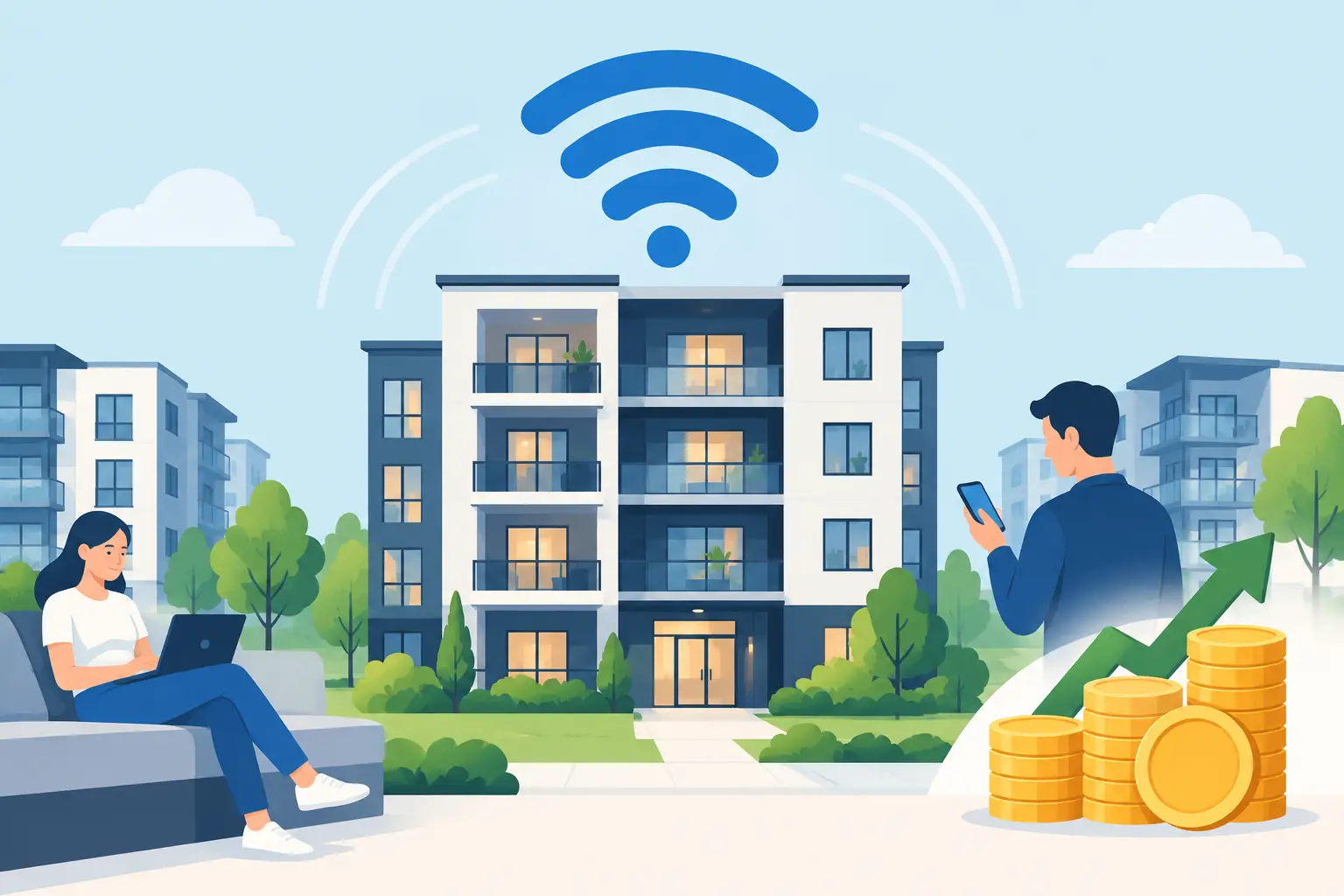
A multifamily property can be carrying thousands of mobile sessions every day without earning a dollar from them. Residents stream in their units, guests connect in lobbies, prospects tour amenity spaces, and staff rely on wireless tools across the property. If the building has managed Wi-Fi and the right network conditions, that activity may represent more than an operating cost. It may qualify for wifi revenue for apartment buildings through cellular carrier offload.
The first step is not buying more equipment or promising residents a new perk. It is determining whether the property has the coverage, network control, usage patterns, and local carrier value to participate. A location qualification review can identify whether existing Wi-Fi is positioned to become part of the future of decentralized networks.
Why apartment Wi-Fi has commercial value
Mobile carriers face a straightforward capacity problem. Cellular networks are like highways: when too many devices use the same local tower, traffic slows down. In dense residential areas, the pressure is often greatest where people spend the most time - at home.
Carrier offload gives mobile operators another route. Rather than keeping every eligible mobile session on the cellular network, a carrier can securely route approved traffic through a participating Wi-Fi network. Technologies such as WiFi Passpoint make this possible by allowing compatible devices to recognize and connect to trusted Wi-Fi automatically, without residents repeatedly choosing a network or entering credentials.
For the carrier, offload can reduce congestion and improve local service quality. For the apartment owner or operator, it creates the potential for recurring compensation tied to a network asset the property already operates. The economic opportunity is not based on charging tenants more for basic internet access. It is based on helping carriers extend capacity where demand already exists.
That distinction matters. Resident Wi-Fi is a service decision. Carrier offload is a telecommunications infrastructure opportunity that can sit alongside a well-managed resident connectivity program.
What drives WiFi revenue for apartment buildings
No two properties generate the same carrier interest. Unit count matters, but it is not the only measure. A 120-unit building in a dense urban neighborhood with strong Wi-Fi coverage and high carrier congestion can be more strategically valuable than a much larger property in an area with abundant cellular capacity.
Carriers and their technology partners typically look at several connected factors:
Dwell time: Apartment residents spend long, predictable periods at the property, creating sustained demand rather than brief connections.
Wi-Fi coverage and quality: Signal strength, capacity, reliability, and coverage in units and shared spaces determine whether the network can carry carrier-grade traffic.
Network control: The owner or operator must have the authority to approve network changes and commercial participation. A locked-down internet contract can limit options.
Location value: Dense neighborhoods, areas near transit, campuses, hospitals, employment centers, and zones with cellular congestion can be especially compelling.
Traffic profile: Active shared spaces, package rooms, leasing offices, pools, coworking lounges, and clubrooms can add meaningful usage beyond in-unit connectivity.
The key point is that apartment buildings are evaluated as physical network locations, not simply as real estate assets. A property’s placement, construction, resident behavior, and network design all shape its value.
The building types most likely to qualify
High-density multifamily communities are an obvious starting point, particularly mid-rise and high-rise buildings in urban and suburban cores. Residents rely on wireless connectivity throughout the day, and the concentration of devices in a relatively compact footprint can make the location relevant to carrier capacity planning.
Student housing can also be attractive. It combines high device usage, substantial dwell time, and frequent demand spikes during evenings, weekends, and academic periods. Senior living communities, corporate housing, and mixed-use residential developments may have similar advantages when Wi-Fi coverage and operator control are in place.
Class A properties with amenity-rich common areas should not assume their opportunity stops at resident satisfaction. A well-connected fitness center, business lounge, rooftop, lobby, and leasing center can strengthen the property’s overall profile. At the same time, an older garden-style community may still qualify if its Wi-Fi reaches a concentrated resident base and the surrounding market has a carrier need.
It depends on the location. There is no universal unit threshold or guaranteed revenue figure that applies to every apartment community. Qualification is more useful than speculation because it assesses the conditions that actually influence carrier participation.
Network control is often the deciding issue
Many apartment owners pay for internet service without owning the operational decisions around their Wi-Fi. That can complicate monetization. A bulk internet provider, managed Wi-Fi vendor, ownership group, or third-party technology agreement may control equipment, authentication, bandwidth allocation, or the right to add carrier traffic.
This does not automatically disqualify a building. It does mean the agreement needs to be reviewed before the property is positioned as an offload location. The questions are practical: Who controls the access points? Can the network be segmented? Is there enough backhaul capacity? Does the provider permit commercial carrier partnerships? Who can approve hardware upgrades or configuration changes?
A carrier-grade approach should protect the resident experience rather than compete with it. Traffic routing, segmentation, quality-of-service policies, and network monitoring are used to keep resident connectivity separate from the carrier offload function. If a proposed arrangement cannot preserve service quality, it is not the right arrangement for the building.
Revenue is only one part of the return
Recurring revenue is the headline, but it is not the only operational benefit. Carrier offload can prompt a closer look at network coverage, capacity planning, and management practices that already affect resident satisfaction. Better visibility into the Wi-Fi environment can help operators address dead zones, overloaded access points, and poor coverage in common areas.
For a property owner, that creates a more disciplined view of Wi-Fi. Instead of treating it as a utility bill or amenity expense, the building can treat connectivity as infrastructure with measurable performance and commercial potential.
There are trade-offs. A property may need network optimization, upgraded access points, improved backhaul, or clearer contractual authority before it can participate. Those requirements should be evaluated against the projected commercial value and the long-term importance of reliable resident connectivity. The strongest opportunity is not the one that makes the biggest claim. It is the one that improves the network while creating a sustainable business case.
A practical path to carrier offload eligibility
Apartment operators do not need to become telecom specialists to evaluate this opportunity. They need a clear picture of the asset they control. Start by gathering basic information about unit count, property type, location, existing Wi-Fi provider, coverage areas, access-point ownership, and the spaces where residents and visitors spend time.
Next, identify decision rights. If the ownership group, property manager, and internet provider all have a role, bring those parties into the discussion early. Carrier offload projects move more effectively when the commercial and technical responsibilities are understood from the start.
Then submit the location for qualification. WiFiRevenueCheck evaluates real-world conditions such as foot traffic, dwell time, available Wi-Fi coverage, network control, and the strategic value of the surrounding area. The goal is not to force every building into a program. It is to identify where carrier demand and property infrastructure align.
The opportunity is already inside the building
Apartment owners have spent years investing in connectivity because residents expect it. That investment is no longer limited to keeping residents online. Where the property and network qualify, the same infrastructure can support carrier capacity, strengthen the building’s technology position, and produce a new form of recurring value.
The next useful question is not whether your building has Wi-Fi. It is whether the Wi-Fi you already operate is positioned to earn its place in wireless infrastructure.
Comments