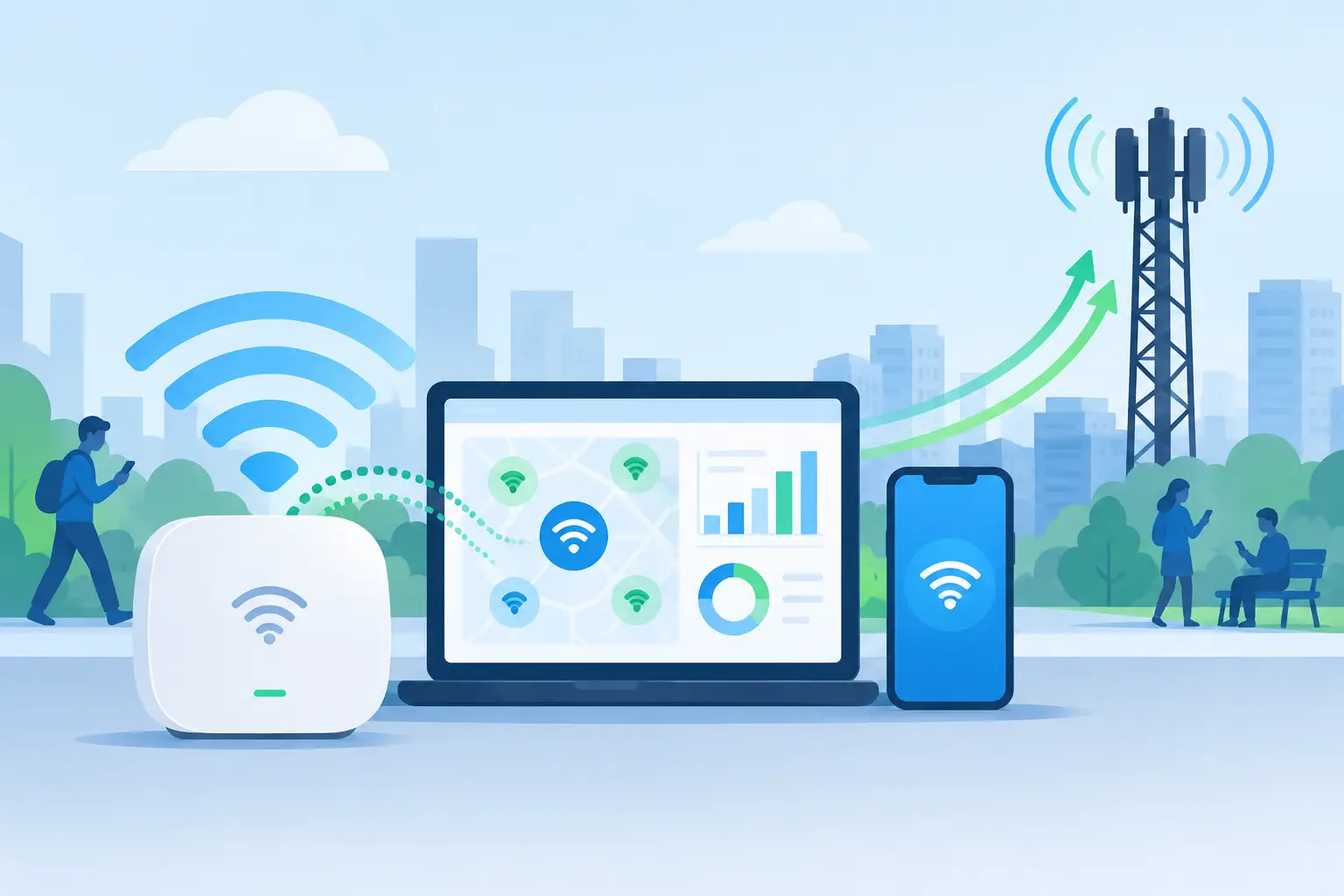
WiFi Network Assessment for Carrier Offload

Before approving another Wi-Fi upgrade or accepting that connectivity is simply a cost of doing business, start with a WiFi network assessment. For many venues, the network already serving guests, tenants, employees, or visitors may be capable of doing more than delivering internet access. With the right technical design and commercial partnership, it can help carry trusted mobile-carrier traffic and become a recurring revenue-producing asset.
That opportunity is not determined by business size alone. A busy independent coffee shop can be more valuable than a larger but lightly used office. A regional hospital campus may have stronger carrier relevance than a storefront with excellent broadband. The assessment identifies where your location sits, how people use it, and whether your network can participate in the future of decentralized wireless infrastructure.
What a WiFi Network Assessment Actually Measures
A WiFi network assessment is not a generic internet speed test. Speed matters, but a single fast result from a laptop says very little about how a network will perform when dozens or hundreds of devices connect throughout the day.
For carrier offload, the assessment looks at both the physical network and the business environment around it. Cellular carriers need Wi-Fi capacity where their customers actually spend time and where their cellular networks benefit from added relief. Think of the cellular network as a highway. When traffic builds near a venue, trusted Wi-Fi can serve as an additional lane, moving eligible users onto a well-managed connection without requiring them to manually search for a network or type in a password.
The goal is to determine whether your Wi-Fi is positioned to handle that role reliably. That requires a view of network performance, coverage, control, security, usage patterns, and local carrier demand.
Network capability and coverage
An assessment reviews whether access points are placed and configured to deliver usable coverage where people gather. In a hotel, that could mean guest rooms, meeting spaces, lobbies, and pool areas. In a retail center, it may mean common areas, storefronts, entrances, and outdoor walkways. A network that looks strong from the manager's office can still have weak areas where customers linger.
Capacity is equally important. The question is not just whether a signal reaches a room. It is whether the network can support many concurrent devices while preserving a quality experience for existing users. Backhaul capacity, access-point density, interference, device mix, and peak-hour utilization all influence the answer.
Venue behavior and commercial value
Carrier offload is location-specific. High foot traffic helps, but dwell time often matters just as much. A stadium has major demand during events. A university has recurring daily usage across a large footprint. A gym may have lower traffic than a retail center but a predictable member base that spends extended time on-site.
The assessment examines the behaviors that make a location strategically useful, including:
visitor volume and peak traffic periods
average time people spend on the property
the areas where people congregate and use data
nearby cellular congestion or coverage challenges
the consistency of the location's operating hours and demand
These factors help distinguish a venue with occasional Wi-Fi use from one that can provide meaningful, repeatable capacity to carrier partners.
Network control and operational readiness
A property cannot monetize Wi-Fi traffic it does not control. If a landlord, tenant, managed service provider, or third-party internet vendor owns key parts of the network, the commercial path may be more complicated. That does not automatically rule out participation, but it changes what must be resolved first.
An assessment clarifies who controls the internet connection, access points, authentication settings, network policies, and upgrade decisions. It also identifies whether the existing environment can support carrier-grade features such as WiFi Passpoint. Passpoint allows eligible carrier subscribers to connect securely and automatically, much like their phone connects to a familiar cellular network. The experience should feel natural to the user while giving the venue and carrier the controls needed to manage traffic responsibly.
Why Existing Wi-Fi Often Has More Value Than Owners Realize
Many operators view Wi-Fi as a required amenity. Guests expect it. Staff need it. Tenants complain when it slows down. The monthly bill is simply part of operating the property.
Carrier offload changes that equation. The infrastructure is already in place, and the assessment determines whether it can be optimized for another role: supporting carrier traffic in high-value locations. Instead of treating every network investment as an expense, owners can evaluate whether better coverage, modern authentication, or targeted hardware improvements create a pathway to revenue.
This does not mean every location qualifies, or that every older network should be forced into a carrier program. A low-traffic site with limited broadband and little strategic relevance may not justify the work. Likewise, a venue with strong demand but poor coverage may need upgrades before it is ready. The value of a proper assessment is that it produces a practical answer rather than a sales pitch based on square footage alone.
What Happens During the Assessment Process
The process typically begins with basic location information: venue type, address, business hours, approximate visitor volume, current Wi-Fi setup, and who manages the network. That initial profile helps establish whether a more detailed review makes sense.
Next comes technical and operational validation. Depending on the property, this can include reviewing network diagrams, internet service capacity, access-point inventory, coverage maps, traffic patterns, existing guest Wi-Fi policies, and the ability to segment traffic. A large multi-location operator may provide centralized network details, while a single venue may start with a simpler discussion about its provider and equipment.
The final review connects the technical findings to commercial potential. A strong assessment does not just say that the network is good or bad. It identifies whether the location is ready for carrier offload, ready with specific improvements, or unlikely to be a fit under current conditions.
That distinction protects the customer experience. Existing guests, employees, and critical business systems should not be sacrificed for a new revenue opportunity. Carrier-grade deployments are designed around traffic routing, capacity planning, security, and performance monitoring so offload traffic can coexist with the business's own needs.
Common Findings and What They Mean
Many otherwise attractive locations need only modest changes. Coverage may be excellent in public areas but weak in a conference wing. The broadband circuit may be sufficient most of the day but undersized during events. Equipment may support modern standards while the current configuration lacks the authentication and segmentation needed for carrier traffic.
Other findings are more structural. A franchise operator may not control the network contract. A shopping center may have multiple independent networks with no unified management. A hospital may need careful separation between public traffic and clinical systems. These are not dead ends, but they require the right stakeholders and deployment plan.
The strongest candidates usually combine several advantages: consistent foot traffic, meaningful dwell time, well-distributed Wi-Fi coverage, reliable internet capacity, and clear authority to make network decisions. Locations near transit corridors, dense commercial districts, campuses, event venues, and areas with cellular congestion can carry additional strategic value.
Questions to Ask Before You Pursue Carrier Offload
Business owners do not need to become telecommunications engineers, but a few questions can quickly reveal whether an assessment is worthwhile. Who owns and operates your Wi-Fi network? Where do guests report weak service? When are your busiest periods? Can your provider share access-point and bandwidth details? Do you have the authority to approve equipment, configuration, and commercial agreements?
It also helps to define your priorities. Some operators are primarily interested in recurring revenue. Others want stronger guest connectivity, a technology modernization plan, or a way to add value across a portfolio of properties. The best opportunity is one where network improvements support both operational needs and commercial goals.
For a multi-location business, do not assume every site will have the same potential. One location near a major commuter hub may be highly attractive, while another location with similar sales volume may not be. Qualification should be based on real conditions at each property.
Turn a Network Expense Into a Location Asset
The business revolution in wireless infrastructure is not about asking venues to take on a second job. It is about recognizing that the places where people gather already form part of the wireless network ecosystem. When a carrier can safely and efficiently route eligible traffic through qualified Wi-Fi, the venue's connectivity becomes more valuable to more than just its own customers.
WiFiRevenueCheck evaluates that opportunity through the realities of your location: people, dwell time, coverage, network control, and surrounding carrier demand. A WiFi network assessment gives you the facts needed to decide whether your existing infrastructure can move from a necessary amenity to an income-producing asset.
Your next useful step is simple: look at your busiest spaces, your busiest hours, and who controls the network behind them. Those answers can reveal whether the Wi-Fi you already pay to operate has a larger role to play.
Comments