Best Venues for WiFi Roaming and Revenue

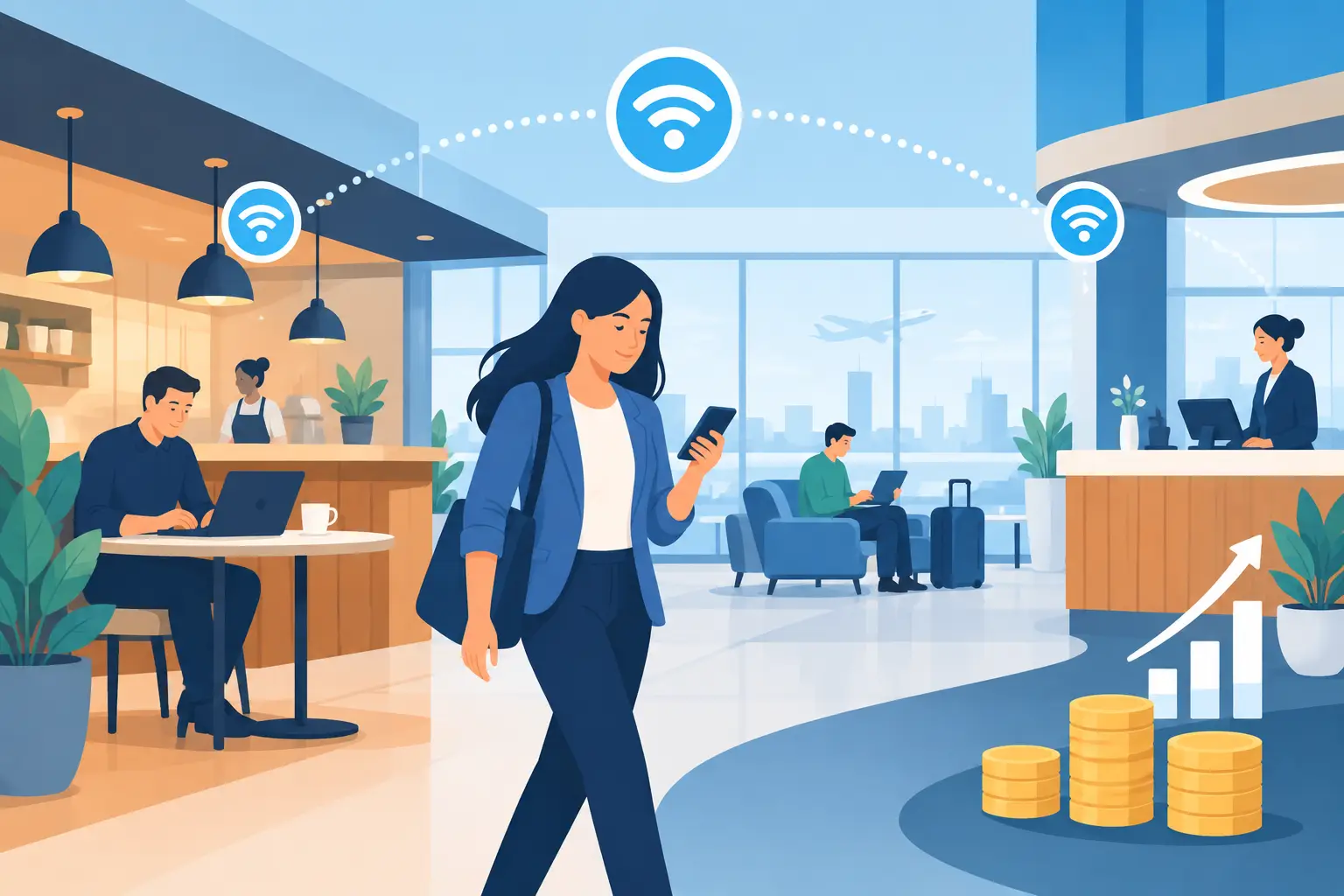
A busy guest Wi-Fi network can be more than an operating cost. For the best venues for wifi roaming, it can become a telecom asset that helps mobile carriers move trusted traffic off congested cellular networks while creating a new recurring revenue opportunity for the property owner.
The opportunity is not limited to massive stadiums or national retail chains. A well-positioned coffee shop, medical campus, hotel, fitness club, or mixed-use property may be valuable because of who visits, how long they stay, and how much mobile demand exists nearby. The infrastructure is often already in place. The question is whether the location has the coverage, control, and traffic profile to participate.
What Makes a Venue Valuable for Wi-Fi Roaming?
Wi-Fi roaming, often enabled through technologies such as WiFi Passpoint, lets qualified mobile users connect to a venue's Wi-Fi automatically and securely. Instead of asking customers to find a network name, accept a splash page, and enter a password, their carrier credentials can identify them in the background. Their phone moves onto the venue's carrier-integrated Wi-Fi much like a car taking an open exit off a crowded highway.
For carriers, this offload can relieve pressure on the cellular network in places where demand is concentrated. For venue owners, the commercial value comes from offering reliable, carrier-grade capacity at a strategically useful location. This is why raw visitor counts alone do not decide eligibility.
A strong roaming venue usually brings together several factors: meaningful foot traffic, enough dwell time for users to connect and consume data, dependable Wi-Fi coverage, and owner control over the network. Local cellular congestion and the venue's proximity to carrier demand zones can matter just as much.
Foot Traffic Is Useful, but Dwell Time Changes the Equation
A transit-adjacent storefront might see thousands of people pass by each day, but only a small share may remain long enough to use Wi-Fi. By contrast, a neighborhood gym with members staying 45 to 90 minutes can produce a more consistent connection environment even with lower daily traffic.
Dwell time matters because roaming value is tied to sustained, usable wireless sessions. Hotels, waiting rooms, university buildings, event spaces, and medical facilities often perform well because people remain on-site while using video, messaging, work applications, social platforms, and cloud services.
Network Control Is a Commercial Requirement
A property cannot monetize a network it does not control. If the internet service, access points, authentication settings, or network management are entirely controlled by a tenant or outside provider, the path to carrier participation can be more complicated.
That does not necessarily disqualify a site. Multi-tenant buildings, shopping centers, and managed properties can still qualify when agreements allow the owner or operator to make network upgrades and authorize commercial use. The key is establishing who can approve technical changes and who receives the economic benefit.
The Best Venues for WiFi Roaming by Location Type
Certain venue categories consistently align with carrier offload needs because they combine predictable usage patterns with commercially manageable Wi-Fi infrastructure. Each category has trade-offs, so a qualification review should look beyond the label on the building.
Hotels, Resorts, and Extended-Stay Properties
Hotels are naturally strong candidates. Guests expect Wi-Fi, stay for long periods, connect multiple devices, and frequently rely on mobile service throughout the property. Lobbies, meeting rooms, restaurants, pools, corridors, and guest rooms all create opportunities for carrier traffic, provided coverage is consistent.
The trade-off is that guest Wi-Fi may already support demanding operations, including streaming, property-management systems, conferences, and staff devices. A carrier offload program must be designed so additional roaming traffic does not compromise the guest experience. Proper capacity planning and network segmentation are essential.
Coffee Shops, Restaurants, and Food Halls
Coffee shops and fast-casual restaurants can create valuable dwell time, especially in urban districts, office corridors, college areas, and transit-heavy neighborhoods. A customer working for two hours over coffee contributes a different usage pattern than someone picking up a mobile order.
Food halls deserve special attention. They concentrate multiple businesses and longer visits under one roof, often with people browsing, dining, working, and waiting. The challenge is ownership structure. A roaming partnership is easiest when the property or operating group controls a unified Wi-Fi network rather than each vendor running separate equipment.
Fitness Centers and Wellness Facilities
Gyms offer repeat traffic and reliable dwell time. Members often stream audio, use connected fitness apps, communicate between sets, or spend time in classes and recovery areas. Larger clubs can also have strong demand across reception areas, studios, locker rooms, lounges, and childcare spaces.
A gym's value rises when it serves a dense residential area or sits near a cellular coverage constraint. Smaller independent studios may still be candidates, but the economics depend on member volume, physical layout, and the quality of existing Wi-Fi coverage.
Hospitals, Medical Offices, and Care Campuses
Healthcare environments are compelling because waits can be long, visitor volume can be steady, and reliable connectivity improves the patient and family experience. Large hospitals, outpatient centers, specialty clinics, and multi-building care campuses may create sustained demand across waiting rooms, cafeterias, lobbies, and public areas.
This category requires added care. Healthcare operators must protect sensitive operations, maintain strict network segmentation, and respect compliance obligations. Public or guest-facing Wi-Fi can potentially support roaming traffic, but it must remain separate from clinical, administrative, and protected systems.
Universities, Schools, and Training Centers
Higher education has dense device usage, long dwell times, and recurring patterns of demand. Students move between classrooms, libraries, recreation facilities, residence halls, dining areas, and event venues with phones constantly seeking connectivity. A campus with existing managed Wi-Fi may have a meaningful foundation for carrier offload.
However, campus networks are often complex. Institutional IT policies, research systems, student housing, and legacy equipment can limit what is feasible. Universities with centralized network governance are generally easier to evaluate than fragmented campuses where every building has different ownership or technical standards.
Retail Centers, Mixed-Use Properties, and Offices
Retail centers can be particularly attractive when they provide property-wide Wi-Fi across common areas, parking zones, food courts, and gathering spaces. The same is true for mixed-use developments where residents, workers, shoppers, and diners create different demand patterns throughout the day.
Office properties should not be dismissed because employee traffic is less public. In dense business districts, a controlled common-area network can help carriers manage daytime congestion around lobbies, amenity floors, conference centers, and ground-floor retail. The strongest opportunities tend to be buildings with an owner-managed network rather than a patchwork of tenant systems.
Event Venues, Arenas, and Stadiums
Large event venues can generate enormous wireless demand in a short window. Concertgoers upload video, use ticketing apps, coordinate with friends, and share content at the same time. This makes stadiums, arenas, convention centers, and large houses of worship strategically valuable where carrier capacity is strained during events.
The trade-off is variability. A venue with only a few major events each year may need a different commercial model than one with weekly games, conventions, or services. Coverage design also has to account for high-density crowds, outdoor areas, entry queues, concourses, and sudden traffic spikes.
A Quick Qualification Check Before You Invest
Before treating Wi-Fi roaming as a revenue channel, property owners should assess the real condition of the location. A carrier partnership is not simply a matter of turning on a feature in an existing router. It requires a network that can be optimized, managed, and trusted at scale.
The most useful initial questions are:
Does the location have consistent customer, visitor, employee, or guest traffic throughout the week?
Do people stay long enough to connect and actively use mobile data?
Is Wi-Fi coverage dependable in the spaces where people actually gather?
Does the owner or operator control the Wi-Fi network and have authority to approve upgrades?
Is the property located near dense population, recurring events, transit, business activity, or known cellular demand?
A "yes" to every question is not required. A high-volume location with limited coverage may still be valuable after a network upgrade. A smaller property can also be strategically important if it fills a carrier coverage gap. Qualification is about the combined business case, not a single metric.
From Guest Wi-Fi Cost Center to Network Asset
The most valuable mindset shift is simple: Wi-Fi no longer has to exist only to satisfy a customer expectation. When a venue qualifies for carrier offload, its connectivity can support better mobile experiences and participate in the future of decentralized wireless infrastructure.
That does not mean every venue should pursue roaming immediately. Properties with weak broadband, aging access points, limited control, or inconsistent visitor patterns may need improvements first. But those improvements can also strengthen everyday operations, guest satisfaction, and the long-term value of the property.
For owners with high-dwell-time, high-traffic locations, the practical next step is to evaluate the site on its actual characteristics. WiFiRevenueCheck helps operators determine whether their existing Wi-Fi footprint has the ingredients carriers need. Your network may already be doing more work than you realize - it may be ready to become a measurable business asset.
Comments