Coffee Shop WiFi Monetization That Can Pay

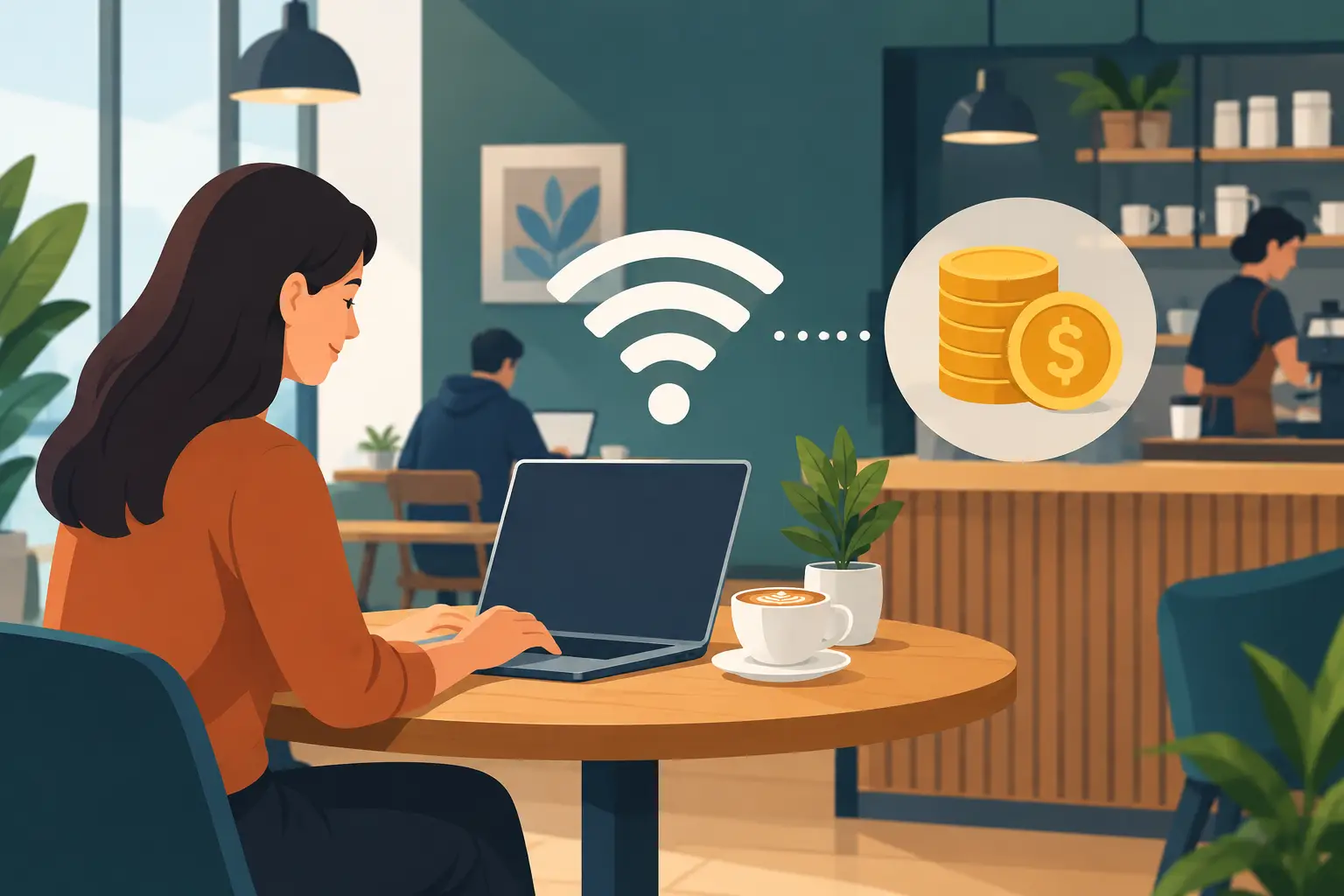
Start with a location qualification check. Coffee shop WiFi monetization is not about charging customers for a password or filling every table with digital ads. It is about determining whether the WiFi your business already operates can carry trusted mobile-carrier traffic and become a recurring revenue-producing asset.
For the right cafe, the opportunity is real. Coffee shops combine the ingredients carriers value most: regular foot traffic, meaningful dwell time, repeat visitors, and customers who use phones heavily while they work, meet, order, and wait. But not every shop qualifies. The difference comes down to the location, the network, and who controls it.
Why Coffee Shops Matter to Cellular Carriers
Think of the cellular network as a highway. When a neighborhood is busy, the highway can become congested, especially during morning commutes, lunch rushes, events, or the workday. Carrier offload creates a reliable alternate route. Compatible phones can move qualifying traffic from the cellular network onto a carrier-approved WiFi network without requiring customers to hunt for a network name or repeatedly enter credentials.
This is valuable to carriers because it improves capacity where people actually gather. It is valuable to coffee shop operators because a network that was once a necessary customer-service expense may qualify as decentralized wireless infrastructure with commercial value.
A cafe does not need to be enormous to matter. A smaller shop beside a transit stop, hospital, university, downtown office cluster, or crowded retail corridor may have more strategic value than a larger shop in a low-demand area. Carriers evaluate need at the location level, not simply by the size of the business.
How Coffee Shop WiFi Monetization Works
Traditional guest WiFi is designed for convenience. A visitor selects a network, accepts terms, and gets online. Carrier offload is designed for trusted connectivity at scale. It generally relies on carrier-grade network equipment, secure traffic routing, and standards such as WiFi Passpoint that allow compatible devices to authenticate automatically.
From the customer perspective, the experience can feel almost invisible. Their phone recognizes an approved network and connects securely when appropriate. From the coffee shop's perspective, the goal is not to manage individual users. The goal is to make qualifying capacity available through the right commercial and technology partners.
The arrangement can create recurring payments based on an agreed commercial model. Specific compensation depends on the carrier partnership, location demand, traffic patterns, technical readiness, and program terms. That is why credible qualification matters. A promised revenue number without a site-level review is speculation, not a business case.
What Makes a Coffee Shop a Strong Candidate?
The strongest candidates usually combine customer activity with network control. A busy cafe is helpful, but it is not enough if the operator cannot approve equipment changes or if the WiFi is controlled entirely by a landlord, franchisor, or third-party provider.
A qualification review typically considers several connected factors:
Foot traffic and dwell time: Customers who remain for 30 minutes, an hour, or longer create a more consistent connectivity environment than quick, transaction-only visits.
Location demand: Dense commercial districts, campuses, medical areas, transportation corridors, and event-adjacent blocks can carry greater strategic importance.
WiFi coverage and capacity: The network should provide dependable coverage where guests sit, order, wait, or work. Dead zones and overloaded access points reduce value.
Network control: Owners or operators need a practical ability to approve network upgrades, access points, internet service changes, and partnership participation.
Backhaul quality: The internet connection behind the WiFi must be capable of supporting added usage without degrading the guest experience.
Multi-location coffee brands can be especially compelling because they offer a repeatable footprint. Still, a single independent shop can qualify if it sits in the right high-demand pocket. It depends on the local wireless environment, not the logo over the door.
High Dwell Time Is an Advantage, Not a Guarantee
Coffee shops have a natural advantage: many guests stay. Remote workers open laptops, students study, friends meet, and commuters wait between appointments. This makes WiFi an expected part of the experience and creates consistent usage patterns.
Yet prolonged use also creates an operational responsibility. If customers already complain about slow connections, an offload opportunity should begin with a network assessment, not a sales pitch. The commercial opportunity works best when carrier-grade improvements strengthen the customer experience rather than compete with it.
Protect the Guest Experience First
The most sensible question is not, “Can we monetize our WiFi?” It is, “Can we monetize it while making connectivity more reliable?” For a coffee shop, the answer must be yes.
A properly designed deployment separates and manages traffic so that customer browsing, point-of-sale systems, staff devices, security cameras, and carrier traffic are handled according to the network plan. Capacity planning, segmentation, monitoring, and professionally installed equipment matter. Your card terminals should not be competing blindly with a packed room of laptops and phones.
There are trade-offs. Adding carrier-grade capability may require upgraded access points, improved internet service, site surveys, or coordination with a landlord. Older equipment may not support the required security or management standards. Shops with thin margins should evaluate installation requirements, ongoing responsibilities, contract terms, and the expected revenue model before making a decision.
That diligence is not friction. It is how a business turns an existing utility into a dependable telecommunications asset without creating a new headache for the store manager.
Common Misunderstandings About Monetizing Cafe WiFi
One misconception is that this means selling customer data. Carrier offload is fundamentally about securely routing authorized carrier traffic through approved WiFi infrastructure. Customer privacy, security practices, and program rules remain central to any legitimate deployment.
Another misconception is that the shop must become a telecom company. It does not. The operator's role is to provide a qualifying venue and participate in the approvals needed to support the network. Technology providers and carrier partners handle the specialized systems, integration, and wireless operations.
A third misconception is that any free guest network will produce revenue. Free WiFi alone is not the product. What matters is whether the site can meet carrier requirements and solves a real coverage or capacity need in the surrounding area.
A Practical Path to Qualification
Start by documenting what you already have: store addresses, approximate daily traffic, busiest periods, typical customer dwell time, current internet service, WiFi equipment, coverage areas, and who has authority over the network. If you lease your space, identify what the lease allows and whether landlord approval is needed for equipment or connectivity changes.
Next, look at the immediate environment. Is the shop near a campus, medical center, office district, transit station, stadium, convention venue, or dense residential area? Does cellular service struggle during predictable busy periods? These details help explain why the location may matter to a carrier beyond the four walls of the cafe.
Then seek a location-based evaluation rather than treating the decision as a generic WiFi upgrade. WiFiRevenueCheck evaluates the conditions that shape carrier offload eligibility, including traffic, dwell time, coverage, network control, and local strategic value. That approach helps operators distinguish a genuine infrastructure opportunity from a vague promise of passive income.
The Bigger Business Shift
For years, coffee shop WiFi has been treated as a cost of hospitality, similar to music, lighting, or clean restrooms. It still supports hospitality, but the underlying infrastructure can now serve another function. A well-positioned network can help relieve cellular congestion while producing financial value for the business that hosts it.
That does not mean every cafe should pursue it. A low-traffic location with limited control over an aging network may not be a fit today. But operators who own or manage active, connected locations should not assume their WiFi is merely an expense line. The infrastructure is already in place, and its next use may be far more valuable than a guest password.
Comments