What Is Cellular WiFi Offload for Businesses?

Your business Wi-Fi may already be positioned to do more than serve guests and employees. If your location has meaningful foot traffic, long dwell times, and reliable coverage, it could be part of the next layer of wireless infrastructure. What is cellular WiFi offload? It is the process of moving eligible mobile-carrier traffic from congested cellular networks onto qualified Wi-Fi networks, giving users stronger connectivity while creating a potential revenue opportunity for the venue that carries that traffic.
For a coffee shop, hotel, hospital, university, retail center, or stadium, this is a different way to think about Wi-Fi. Instead of treating it only as an operating expense or guest amenity, carrier offload can turn well-managed wireless infrastructure into a telecommunications asset.
What Is Cellular WiFi Offload?
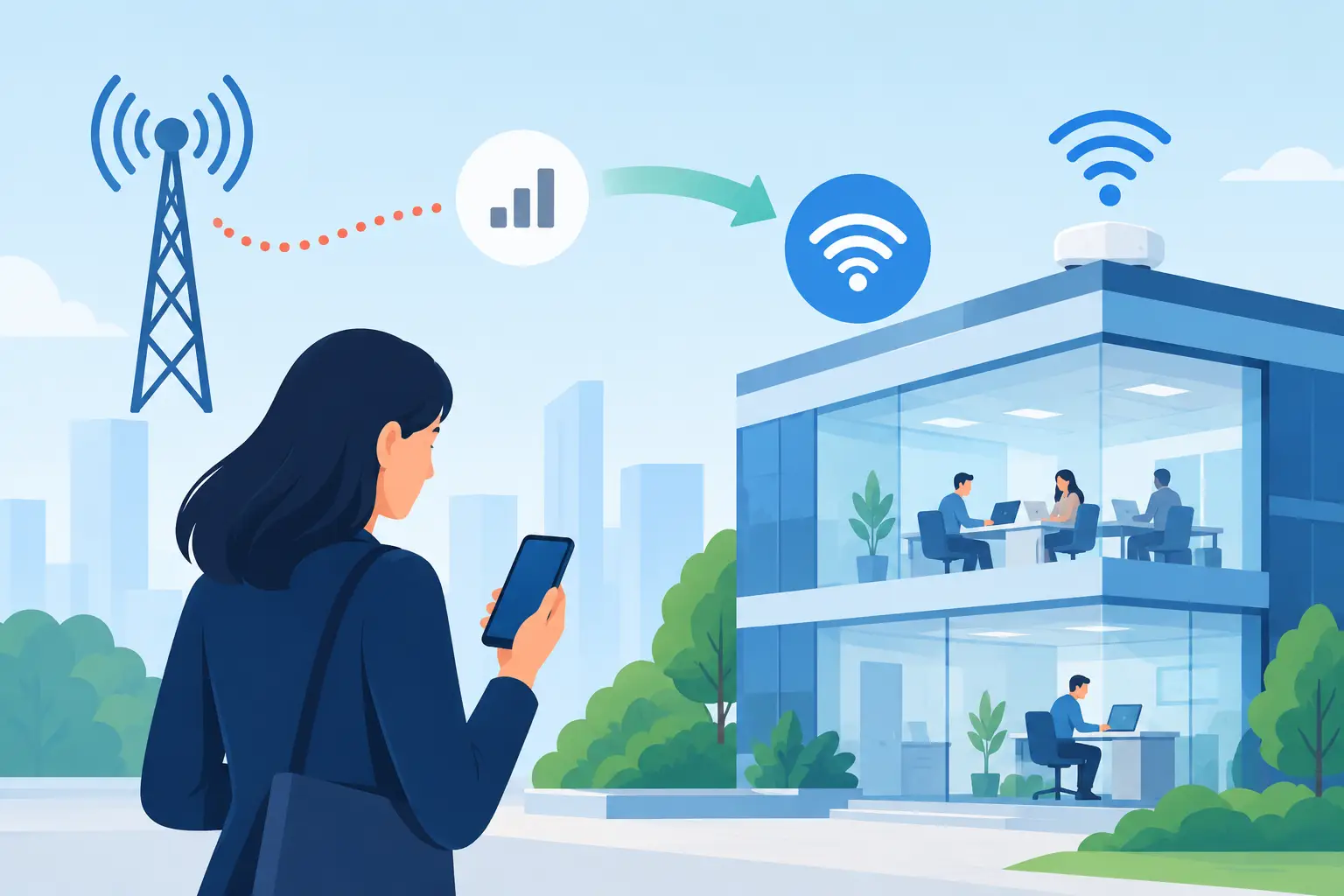
Cellular WiFi offload, often called carrier Wi-Fi offload, allows a mobile carrier to route some of its subscribers' data traffic through a trusted third-party Wi-Fi network. The customer still uses their phone as usual. Their carrier relationship remains the same, but the data session may travel across the venue's Wi-Fi rather than relying entirely on the nearby cellular tower.
Think of the cellular network as a highway. During busy periods, towers can become crowded with phones competing for limited radio capacity. A carrier-grade Wi-Fi network at a nearby venue can operate like a well-designed alternate route. It takes qualified traffic off the highway, reducing pressure on the tower and helping customers get a more reliable connection where they spend time.
This is not the same as simply putting up a free guest Wi-Fi password. Consumer guest Wi-Fi is designed around a visitor manually joining a network, accepting terms, and entering credentials. Carrier offload uses technology and commercial agreements that allow approved carrier devices to identify, authenticate, and connect to participating Wi-Fi networks securely.
How Cellular WiFi Offload Works at a Venue
The experience is intended to be largely automatic for the mobile user. When a carrier subscriber enters a participating property, their device can recognize the qualified Wi-Fi network and connect based on carrier-approved credentials and policies. The customer does not need to ask for a password, search through a long list of network names, or understand what is happening in the background.
A common technology behind this experience is WiFi Passpoint. Passpoint-enabled networks use standardized authentication methods so a phone can securely identify a trusted network and join it automatically. It is closer to how a device moves between cellular towers than how someone traditionally logs into public Wi-Fi.
Behind the scenes, several things must work together: the venue's access points and internet connection, network design, security controls, carrier-grade authentication, traffic-routing policies, and an offload partnership that defines how the location is compensated. The carrier decides which traffic is eligible for offload. The venue provides the physical Wi-Fi coverage and capacity that make the service possible.
The result is a more controlled arrangement than an open public hotspot. Carrier traffic is managed according to technical and commercial requirements, while the venue retains a clear separation between its business operations, private networks, guest connectivity, and offload services.
Why Carriers Need More Wi-Fi Capacity
Mobile carriers continuously add spectrum, upgrade towers, and invest in 5G infrastructure. Yet demand is not spread evenly across a city. It concentrates in places where people gather, wait, work, shop, study, and stream content.
A hotel lobby can fill with guests checking in at the same time. A medical campus may have visitors, staff, and patients using mobile devices all day. A sports venue can see tens of thousands of people upload videos and access ticketing apps within a narrow time window. In these environments, network congestion is often a location-specific problem, not simply a citywide one.
That is where decentralized wireless infrastructure becomes valuable. Rather than solving every capacity challenge with another macro tower, carriers can extend their network through high-quality Wi-Fi at strategically useful properties. The infrastructure is already in place at many businesses. What matters is whether it can meet the technical and commercial standards required for carrier participation.
What Businesses Gain From Carrier Offload
The central opportunity is straightforward: a business may be able to generate recurring revenue from Wi-Fi infrastructure it already owns, operates, or pays to maintain. The exact economics vary by partnership, traffic value, geography, and network performance, but the model changes the conversation from "How much does Wi-Fi cost us?" to "What value can our Wi-Fi produce?"
There are operational benefits as well. A professionally optimized offload network can improve coverage and capacity for guests, tenants, customers, and employees. Better connectivity can support digital ordering, mobile check-in, point-of-sale tools, property apps, telehealth workflows, and everyday communications.
For multi-location operators and commercial property owners, the opportunity can be especially meaningful. A single site may not be the whole story. A portfolio of gyms, retail stores, hotels, medical offices, or campuses can create a broader footprint in areas carriers want to serve. Network value is driven by the real-world characteristics of each location, not just the size of the company behind it.
Which Locations Are Most Valuable?
Not every Wi-Fi network is a fit for cellular offload. Carriers and technology partners generally look for locations where people are present long enough to use meaningful data, where Wi-Fi can be deployed and managed reliably, and where offloading traffic would relieve demand on the surrounding cellular network.
High-potential properties often include hospitality venues, restaurants and coffee shops, fitness centers, healthcare facilities, universities, office campuses, retail centers, event spaces, transit-adjacent locations, houses of worship, and large entertainment venues. A busy location is helpful, but it is not the only factor.
Qualification typically considers four practical questions. Is there consistent foot traffic or device density? Do people stay long enough for Wi-Fi use to matter? Is there sufficient indoor or outdoor coverage where people actually gather? And does the owner have the authority to upgrade, manage, or approve access to the network?
A smaller clinic near a congested corridor may be more strategically useful than a much larger building in an area with abundant cellular capacity. Likewise, a high-traffic venue with weak backhaul, fragmented network control, or poor access-point coverage may need upgrades before it can support carrier-grade traffic.
The Requirements Behind a Revenue-Ready Network
Carrier offload is an infrastructure opportunity, not a plug-and-play app. A location must be able to deliver dependable service. That usually means adequate broadband capacity, modern access points, purposeful coverage design, secure segmentation, and ongoing monitoring.
Network control matters just as much as network equipment. If a tenant uses a shared building network, or if a franchise operator cannot approve changes to the Wi-Fi environment, the property may be harder to qualify. Owners and operators with clear control over their connectivity are generally in a stronger position to participate.
Security also deserves attention. The goal is not to expose a business network to outside users. A well-designed deployment separates traffic and applies authentication and policy controls. The right technology partner evaluates the existing environment, identifies gaps, and designs the offload layer so business-critical systems remain protected.
There are trade-offs. An upgrade may be needed, particularly at older properties or sites with incomplete coverage. Revenue is not guaranteed simply because a venue has Wi-Fi. Carriers value performance, strategic geography, traffic patterns, and reliability. A credible qualification process should set realistic expectations rather than treating every access point as automatically monetizable.
From Guest Amenity to Wireless Asset
For years, businesses installed Wi-Fi because customers expected it. That expectation has not disappeared, but the economics around connectivity are changing. Wi-Fi is becoming part of the distributed infrastructure that supports how mobile networks handle growing demand in the places people use their phones most.
This shift gives property owners a practical choice. They can continue viewing Wi-Fi as a necessary cost of doing business, or they can evaluate whether their network, location, and customer activity create a new source of value. WiFiRevenueCheck helps businesses assess that opportunity based on the factors that matter in the real world: coverage, dwell time, traffic, network control, and the carrier value of the surrounding area.
The strongest next step is not to assume your location qualifies or dismiss the idea because you are not a telecom company. Review what you already have, identify where people connect, and find out whether your Wi-Fi can earn a role in the future of decentralized networks.
Comments