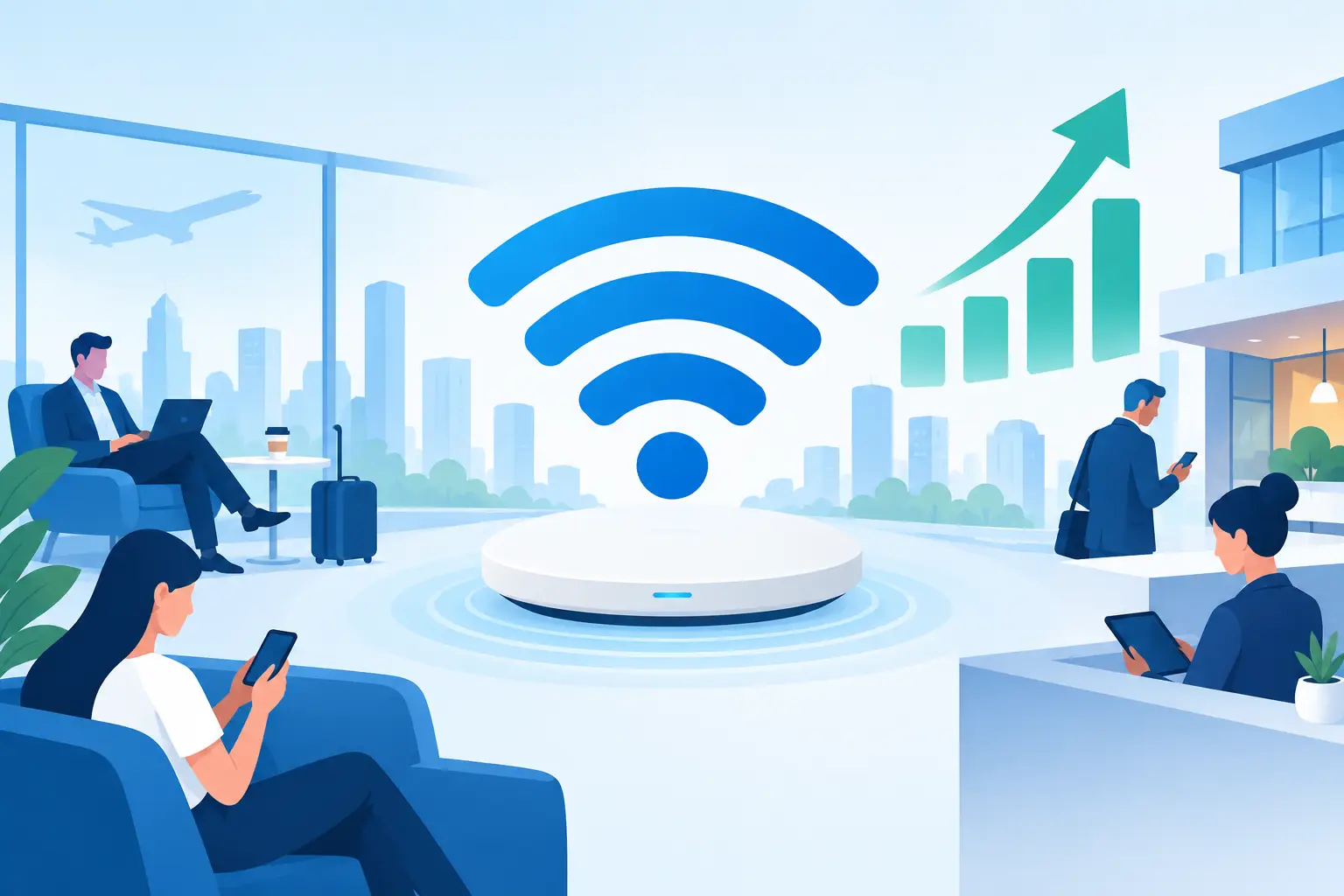
Carrier Grade WiFi Requirements That Drive Revenue

If your location has steady visitor traffic and Wi-Fi that people already use, it may be closer to carrier offload revenue than you think. The carrier grade wifi requirements are not reserved for massive stadiums or telecom companies. Many hotels, gyms, medical campuses, retail centers, offices, and hospitality venues already have much of the underlying infrastructure in place. The opportunity is to determine whether that infrastructure can reliably carry trusted mobile-carrier traffic - and whether the location has the commercial value carriers need.
Carrier offload turns Wi-Fi from a customer-service cost into a telecommunications asset. When nearby cellular networks become crowded, participating devices can move eligible traffic onto a qualified Wi-Fi network. Customers get better connectivity, carriers gain added capacity where it matters, and qualifying venue owners can create a recurring revenue opportunity from infrastructure they already operate.
What Makes Wi-Fi Carrier Grade?
Carrier grade does not simply mean fast internet. A consumer-grade network may perform well for a few guests checking email, then struggle when a lunch rush, conference break, or shift change puts hundreds of devices online at once. Carrier-grade Wi-Fi is designed, managed, and validated to deliver predictable service under real operating conditions.
Think of the cellular network as a highway. During normal traffic, it works well. At peak periods, the highway bottlenecks around the places where people gather. Carrier offload creates a well-managed alternate route, moving approved traffic onto Wi-Fi without asking the customer to hunt for a network, type a password, or open a browser page.
That experience typically relies on Wi-Fi Passpoint and related carrier authentication methods. A compatible phone recognizes the eligible network and connects securely based on its carrier credentials. For the venue, the key question is not whether guests can see a Wi-Fi name. It is whether the network can become a dependable extension of carrier capacity.
The Core Carrier Grade WiFi Requirements
A carrier evaluates both the network and the location around it. Strong equipment alone is not enough if the venue is empty most of the day. Heavy foot traffic alone is not enough if the Wi-Fi has weak coverage, limited backhaul, or no clear operational owner.
Consistent coverage where people actually stay
Coverage needs to reach the areas where visitors, customers, patients, students, or employees spend time. A hotel lobby with excellent signal but weak guest-floor coverage may have limited offload value. A retail center may need meaningful coverage across common areas, not only inside a single tenant suite.
Coverage also needs to be measured, not assumed. Walls, elevators, kitchen equipment, shelving, outdoor seating, construction materials, and neighboring wireless networks can all affect signal quality. A carrier-grade design accounts for these realities through access point placement, channel planning, and capacity planning.
Enough capacity for peak demand
Internet speed is part of the picture, but available capacity at busy moments matters more. A coffee shop may appear well provisioned at 8 a.m. and become constrained by 10 a.m. A venue network must support its own business operations, guest use, and potential carrier traffic without creating a worse experience for anyone.
Backhaul should have sufficient bandwidth and a stable connection to the internet. The appropriate amount depends on the location. A small fitness studio and a multi-building hospital do not need the same design. What carriers want is confidence that service remains predictable when usage rises, not a theoretical speed test performed after hours.
Professional network hardware and design
Carrier participation generally requires commercial-grade access points, switching, gateways or firewalls, and a network architecture that can be monitored and managed. Consumer mesh equipment may be appropriate for a small home or very small storefront, but it rarely provides the visibility, segmentation, and reliability needed for carrier traffic.
The network should also separate guest, business-critical, and carrier-related traffic appropriately. Point-of-sale systems, security devices, staff applications, and medical or operational systems should not compete blindly with public traffic. Good segmentation protects operations and allows network policies to be enforced without compromising customer access.
Secure authentication and traffic handling
Security is foundational because carrier offload is not an open public hotspot. Carrier-grade Wi-Fi must support trusted authentication, encrypted connections, and controlled traffic routing. Passpoint is a common piece of this model because it enables approved devices to connect automatically and securely.
Venue operators do not need to become wireless engineers to benefit. They do need a network partner and architecture capable of meeting the technical requirements, applying policy changes, and addressing issues without disrupting the business. Carrier traffic must be handled as a managed service, not as an unmanaged add-on.
Visibility, monitoring, and uptime accountability
A carrier needs to know how the network is performing. That means the ability to monitor availability, device health, bandwidth use, latency, packet loss, and other service indicators. When a problem occurs, there must be a defined path to identify it and resolve it.
This is where carrier-grade expectations differ sharply from ordinary guest Wi-Fi. If a single access point goes offline in an unused back office, the impact may be minor. If coverage disappears from a high-traffic airport-adjacent lobby during a busy period, the location can lose meaningful offload capacity. Proactive monitoring and clear service responsibilities make that difference manageable.
The Location Requirements Matter Just as Much
Carriers invest where their subscribers need extra capacity. That makes location economics central to qualification. A well-built network in a remote, low-traffic building may not be a priority, while an imperfect network at a high-value venue may justify an upgrade path.
High-potential locations often share several characteristics: recurring foot traffic, meaningful dwell time, dense device use, and proximity to places where cellular demand can spike. A busy restaurant near a sports arena, a hotel by a convention center, a hospital campus, a university, or a retail center near major transit can all have strategic value.
Dwell time is especially relevant. People who remain onsite for 30 minutes, two hours, or several days create more opportunity than visitors who pass through in a minute. That does not mean short-stay locations cannot qualify. It means the revenue potential and network design should match the way people use the property.
Network Control Is a Non-Negotiable Factor
One of the most overlooked carrier grade wifi requirements is control. A property owner may have Wi-Fi on site but lack authority to change network settings, approve new equipment, separate traffic, or permit a third party to manage the environment. In that case, the network may be technically capable but commercially difficult to enroll.
The ideal operator can authorize access to the network, coordinate with its IT provider, and approve upgrades when justified. For multi-tenant properties, this may involve the landlord, managed service provider, facilities team, and major tenants. Clarifying ownership early prevents delays later.
This is also why existing Wi-Fi is an advantage, not an automatic qualification. The infrastructure is already in place, but its ownership model, coverage map, equipment age, and operational policies determine how quickly it can become carrier-ready.
What Upgrades May Be Needed?
Qualification does not require perfection on day one. Many eligible locations need optimization before they can support carrier offload. That may include adding access points to eliminate dead zones, replacing aging hardware, increasing internet capacity, improving segmentation, or installing management tools that give the network operator better visibility.
The right upgrade should be tied to a clear commercial case. A high-dwell-time hotel with known cellular congestion may justify more investment than a small location with limited traffic. The goal is not to overbuild a network. It is to create reliable capacity where carriers and their subscribers can use it.
For business owners, that distinction matters. You are not buying technology for technology's sake. You are evaluating whether an existing operating expense can become a higher-value asset with a defined role in the future of decentralized wireless infrastructure.
Start With a Real Qualification Review
The most useful first step is an assessment of the location, not a guess based on square footage or internet speed. A proper review looks at foot traffic, dwell time, existing coverage, network control, surrounding cellular demand, and the practical ability to optimize the site.
WiFiRevenueCheck helps businesses and property owners view their Wi-Fi through that commercial lens. A location that serves customers, employees, guests, patients, students, or event attendees may already hold more wireless value than its current utility bill suggests. The next move is to find out whether your network can carry more than internet access - and start working as a revenue-producing part of the wireless economy.
Comments