WiFi Offload for Hospitals Can Create New Value

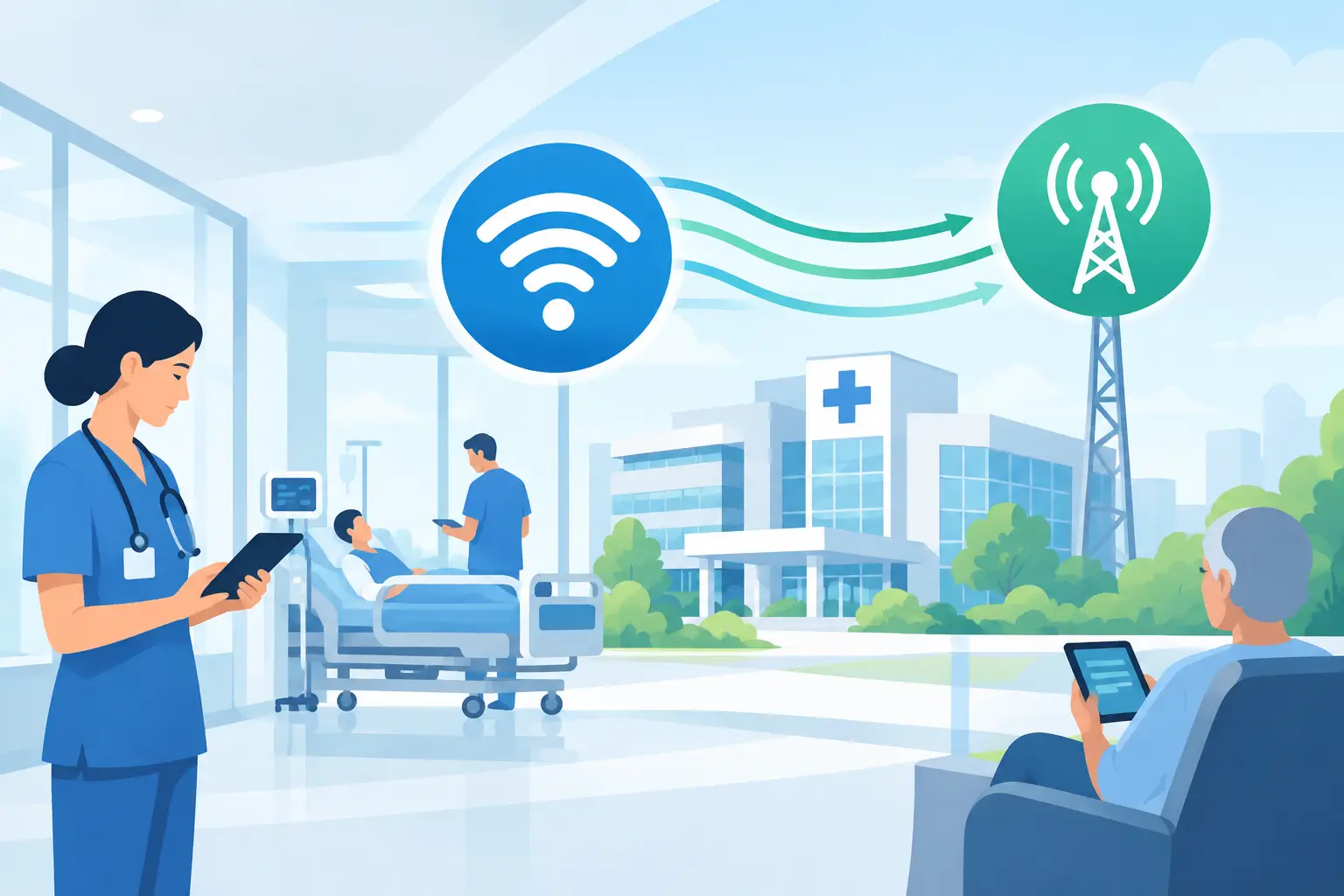
Before treating another Wi-Fi upgrade as a pure operating cost, hospital leaders should ask a different question: can the network already support a new revenue opportunity? WiFi offload for hospitals can route trusted cellular-carrier traffic through qualified on-site Wi-Fi, helping carriers manage demand while allowing healthcare properties to extract more value from infrastructure they already operate.
For a hospital, connectivity is not a lobby amenity. It supports clinicians, patients, visitors, administrative staff, mobile devices, and critical care workflows across a complex physical environment. That makes qualification more demanding than it is for a typical public venue. It also makes qualifying hospital locations strategically valuable to carriers seeking coverage where people spend significant time and expect their phones to work.
Why Hospitals Matter to Carrier Networks
Hospitals create the kind of traffic patterns mobile carriers cannot ignore. Patients may remain on site for hours or days. Visitors wait in rooms, cafeterias, lobbies, and outpatient areas. Staff work long shifts, often moving between floors and buildings while relying on smartphones for communication, scheduling, and everyday life.
Cellular demand is rarely evenly distributed. A hospital campus can have areas where signal is strong outdoors but inconsistent inside, particularly in lower levels, interior patient rooms, imaging areas, large concrete structures, and parking facilities. When a carrier's cellular network becomes crowded or weakened by building materials, properly deployed Wi-Fi can provide another path for eligible device traffic.
Think of the carrier network as a highway. During heavy demand, carrier offload gives selected traffic an alternate, managed route over the hospital's Wi-Fi infrastructure. The objective is not to replace cellular service. It is to extend carrier capacity where it is useful, while maintaining the controls a healthcare environment requires.
How WiFi Offload for Hospitals Works
Carrier offload is different from asking guests to choose a public network, accept terms, and re-enter credentials every visit. With carrier-grade Wi-Fi technologies such as Passpoint, eligible phones can recognize an authorized network and connect automatically based on the subscriber's carrier relationship.
The hospital does not become a cellular carrier. Instead, a qualified location can host the Wi-Fi access points, coverage, and network environment needed to carry approved carrier traffic. That traffic is routed under defined technical and commercial arrangements, with the carrier-grade platform handling authentication, policy, and connection management.
For users, the experience should feel natural: their device has connectivity in areas where cellular service may be challenged, without repetitive sign-in prompts. For carriers, the property becomes part of a broader decentralized wireless infrastructure strategy. For hospital operators, existing Wi-Fi shifts from being only a service expense to an asset that may support recurring revenue.
That opportunity depends on design. A consumer-grade guest network with partial coverage is not automatically ready for carrier offload. The network must be assessed for coverage quality, capacity, control, security architecture, and the practical ability to separate carrier traffic from hospital operations.
Patient Care Comes First
A hospital should never pursue monetization at the expense of clinical performance, privacy, or safety. The first rule is simple: carrier offload must not compete with systems that support patient care.
Clinical networks may serve electronic health record access, nurse communications, connected medical devices, imaging workflows, building systems, and other operational functions. Guest Wi-Fi and carrier-offload traffic should be designed with appropriate segmentation, capacity planning, monitoring, and governance. The exact architecture varies by campus, but the operating principle does not: critical traffic receives priority and clear separation.
Healthcare leaders also need to distinguish between network transport and protected health information. Carrier-offload programs should not require a venue operator to inspect, collect, or expose patient information. Still, every deployment requires review by the hospital's IT, security, compliance, and legal stakeholders. HIPAA obligations, internal security policies, vendor risk requirements, and local procurement standards remain central to the decision.
The best opportunity is usually a controlled one. Hospitals with strong network management, documented access policies, and a clear understanding of their Wi-Fi footprint are generally better positioned than organizations trying to build an offload program on an unmanaged or fragmented network.
Which Hospital Areas May Have the Most Value?
Value is driven by more than bed count or campus size. Carriers evaluate where people spend time, how devices move through the property, local cellular conditions, and whether the venue fills a meaningful coverage or capacity need in the surrounding market.
High-interest areas can include public-facing lobbies, emergency department waiting rooms, outpatient and specialty-care centers, medical office buildings, cafeterias, family lounges, parking structures, and large connected campuses. These areas combine dwell time with repeated visitor and staff activity.
A major academic medical center may present a strong case because of its scale, multiple buildings, high daily population, and continuous use. But a smaller regional hospital can also be valuable if it serves an area with limited carrier capacity, challenging indoor coverage, or strategic importance to a carrier.
A practical qualification review typically considers:
Daily foot traffic, repeat visits, and average time spent on site
Existing Wi-Fi coverage, access-point density, and available capacity
Who controls the network, including whether a third-party provider limits changes
Indoor cellular performance and localized congestion patterns
Campus geography, surrounding carrier demand, and the ability to support secure implementation
There is no universal revenue number or automatic approval threshold. Carrier demand changes by market, and commercial terms depend on technical readiness and location value. A candid assessment is more useful than an inflated promise.
The Business Case Is Bigger Than Guest Wi-Fi
Hospitals already invest heavily in connectivity. They pay for internet service, access points, network staff, security tools, maintenance, and periodic upgrades. Guest connectivity can improve patient and visitor experience, but it has traditionally been categorized as a cost center.
Carrier offload introduces a different model. When a hospital's Wi-Fi has the right characteristics, it may participate in commercial partnerships that generate recurring payments for carrying qualified traffic. The property is no longer only buying connectivity for internal use. It may be providing a valuable piece of wireless coverage infrastructure.
That does not mean every hospital should redesign its network around offload revenue. A system with aging equipment, inconsistent coverage, limited backhaul, or weak operational ownership may need upgrades before it is a fit. In those cases, the potential revenue can be part of the justification for modernization, but it should not override clinical and financial priorities.
For multi-site health systems, the opportunity may be especially compelling. A portfolio of hospitals, clinics, urgent care centers, medical office buildings, and outpatient facilities can be evaluated location by location. One flagship campus may qualify immediately, while other sites may become candidates after targeted network improvements. Portfolio visibility makes it easier to prioritize investments where they have both operational and commercial value.
Questions Hospital Leaders Should Ask First
The right starting point is not, "How quickly can we add carrier traffic?" It is, "What do we have, who controls it, and what must remain protected?"
Facilities, IT, and finance leaders should begin with an accurate map of the Wi-Fi environment. Identify public, staff, clinical, and operational networks; document coverage gaps; confirm internet capacity; and clarify whether the hospital owns the access points and switching infrastructure or relies on a managed provider. Contract terms matter because the ability to modify or monetize the network may be limited by an existing agreement.
Next, establish the internal review team early. IT and security will assess technical fit. Compliance and legal will define guardrails. Facilities can address access, power, and construction realities. Finance can evaluate recurring revenue against upgrade costs, management obligations, and contract terms. Bringing those groups in at the beginning prevents a promising commercial idea from becoming a late-stage governance problem.
Finally, evaluate the location through a carrier lens. High dwell time is useful, but it is not enough on its own. The strongest candidates combine sustained population, meaningful indoor connectivity demand, carrier relevance, network control, and a clear path to protected deployment.
Turn a Network Review Into a Strategic Decision
Healthcare connectivity is becoming more valuable, not less. As more devices, visitors, and staff depend on reliable wireless access, hospitals occupy a meaningful place in the future of decentralized networks. The infrastructure may already be on the property. The opportunity is to determine whether it can serve both care operations and a carefully governed commercial role.
WiFiRevenueCheck helps property and venue operators evaluate whether their existing Wi-Fi environment has the location characteristics and network control needed for carrier offload consideration. For hospitals, a qualification review can provide a disciplined first look without treating clinical connectivity as an afterthought.
A well-managed hospital network should first protect care delivery. If it can also carry trusted carrier traffic under the right technical, security, and commercial terms, that same infrastructure may become a more productive asset for the organization.
Comments