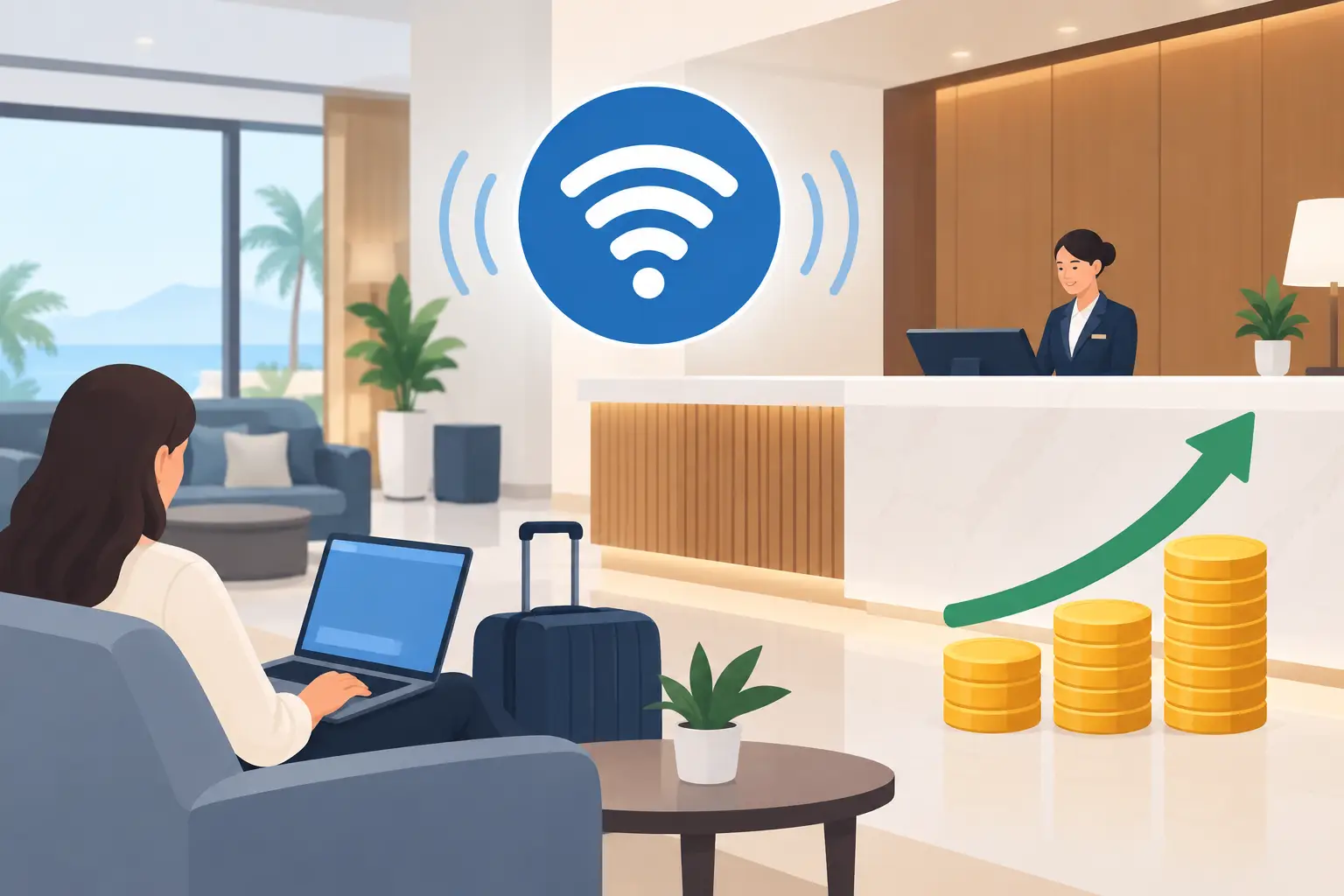
WiFi Monetization for Hotels That Earns More

Start with a location qualification check. wifi monetization for hotels is not about charging guests for basic internet access or filling the login page with ads. It is about evaluating whether the Wi-Fi your property already operates can carry approved mobile-carrier traffic and create a new recurring revenue opportunity.
For hotel owners and operators, that distinction matters. Guest Wi-Fi is already a core operating expectation. Carrier offload can turn part of that necessary infrastructure from a cost center into a telecommunications asset, while keeping the guest experience at the center of the decision.
Why Hotels Are Strong Candidates for Carrier Offload
Hotels combine several characteristics mobile carriers value: predictable foot traffic, long dwell times, indoor coverage challenges, and repeat device usage. A guest may spend hours on property in a room, meeting space, restaurant, lobby, fitness center, or pool area. Staff members are also connected throughout their shifts. That concentration of people and devices can make a hotel strategically useful to a carrier managing cellular network demand.
Think of a cellular network as a highway. When a hotel is full, hundreds of phones may be trying to use the same nearby cellular lanes for video calls, messaging, work applications, maps, streaming, and background app traffic. Carrier offload creates an alternate route. Eligible devices connect securely to a participating Wi-Fi network, and appropriate traffic is routed over Wi-Fi rather than adding pressure to the cellular network.
The result can be valuable for everyone involved. Guests and staff can experience stronger connectivity indoors. Carriers gain capacity where it is needed. The property owner may earn revenue for contributing infrastructure that is already in place.
That does not mean every hotel automatically qualifies. A 20-room roadside property with limited occupancy and basic consumer-grade Wi-Fi may have a different opportunity profile than a 300-room airport hotel, resort, convention hotel, urban boutique property, or multi-property portfolio. The value depends on real location and network conditions, not simply the number of rooms.
How WiFi Monetization for Hotels Works
Carrier offload is designed to operate behind the scenes. Rather than asking a guest to choose a special carrier network, participating phones can recognize and connect to approved Wi-Fi through technologies such as WiFi Passpoint.
Passpoint is often easiest to understand as a trusted digital credential. When a compatible device enters a participating location, it can authenticate automatically and securely, much like a phone reconnects to a known network without requiring the user to type a password each time. The technical setup, traffic routing, and carrier relationships are handled through carrier-grade network technology and commercial partners.
For the hotel, the process generally begins with an assessment of the existing environment. That review looks at Wi-Fi coverage, access point placement, internet capacity, network ownership, guest density, and the property's value within the surrounding wireless landscape. A hotel near an airport, convention center, hospital district, stadium, transit hub, or dense business corridor may be particularly relevant because carrier demand is rarely uniform.
If a location is a fit, the network may need optimization or equipment upgrades to meet program requirements. The goal is not to turn the hotel into a telecom operator. It is to build a managed path for the property to participate in decentralized wireless infrastructure without compromising the services guests depend on.
The Revenue Opportunity Is Real, but It Is Not One-Size-Fits-All
The commercial case for carrier offload is recurring revenue tied to the property’s ability to carry qualifying traffic under an approved partnership. It is fundamentally different from selling premium Wi-Fi tiers, sponsorships, or guest data.
Revenue potential can depend on carrier demand in the area, compatible-device traffic, occupancy patterns, quality of network coverage, available backhaul capacity, and the specific commercial arrangement. A property with exceptional coverage but very low traffic may have less value than a busy hotel with moderate room count near a congested cellular corridor. Conversely, a large resort may need a more complex coverage plan before it is ready.
That is why operators should be cautious around blanket earnings claims. The right question is not, "How much does every hotel make?" It is, "Does this location solve a meaningful carrier capacity need, and can it do so without weakening our guest network?"
A credible qualification process answers that question before making assumptions about financial outcomes.
What Hotel Operators Need to Protect
A new revenue stream only works if it supports the hotel’s operating standards. For most hospitality teams, guest satisfaction, security, brand requirements, and uptime will always outrank a new technology program. Carrier offload should be designed around those realities.
First, guest Wi-Fi performance must remain protected. A properly engineered deployment uses capacity planning, traffic policies, and network segmentation so carrier-related traffic does not crowd out hotel operations, guest streaming, point-of-sale systems, property management systems, or staff devices. More traffic without adequate backhaul is not monetization. It is a service problem waiting to happen.
Second, hotel networks need clear security boundaries. Guest, employee, operational, and carrier traffic should not be treated as one open pool. Segmentation and managed network controls are essential, especially for properties handling payments, loyalty data, room access systems, and connected building equipment.
Third, brand and ownership structure matter. A franchise property may need approval from brand technology teams. A managed hotel may require alignment among the owner, operator, IT provider, and asset manager. In a multi-property portfolio, standardizing network documentation and governance can make evaluation faster and create more consistent rollout decisions.
Hotel Locations With the Strongest Potential
High room counts help, but they are only one signal. The strongest candidates often combine sustained on-property activity with a location that matters to nearby cellular networks. Consider the difference between a hotel whose guests arrive late, sleep, and leave early, and a property with a busy lobby, restaurant, meeting rooms, conference attendees, airline crews, and daily events. Both offer Wi-Fi, but their traffic patterns are very different.
Properties that often warrant a closer look include:
Airport hotels serving travelers and flight crews
Convention and conference hotels with concentrated device demand
Urban hotels in dense cellular corridors
Resorts with broad indoor and outdoor guest areas
Hotels near stadiums, hospitals, campuses, or transit centers
Large select-service or extended-stay properties with high occupancy and long dwell time
Even within these categories, eligibility varies. An airport hotel with poor Wi-Fi coverage in meeting areas may need improvement before it can support carrier-grade traffic. A smaller independent hotel in a carrier-congested downtown area may be more attractive than expected. The location check should look beyond property type.
Questions to Ask Before You Move Forward
Hotel operators do not need to become network engineers, but they should expect straightforward answers from any potential program partner. Who controls the Wi-Fi network and has authority to approve changes? Is the current network managed, documented, and capable of supporting additional traffic? Where are the known guest connectivity complaints? What happens if the program requires new access points, switching equipment, or more internet capacity?
Commercial clarity matters just as much. Ask how revenue is measured, what costs are the property’s responsibility, whether equipment ownership changes, and how performance is monitored. Ask what protections are in place for guest experience and operational systems. A serious program should make these details understandable before deployment, not after.
For owners with several properties, there is also a portfolio question: which hotels are most likely to qualify first? Starting with the right locations can create practical operating experience and reveal where future upgrades will have the greatest business value.
Turn Hospitality Wi-Fi Into a Business Asset
Hotels have spent years treating Wi-Fi as an expected amenity and a recurring expense. That expectation is not going away. What is changing is the role the network can play in the broader wireless ecosystem.
Carrier offload will not fit every property, and it should never be forced onto an underperforming guest network. But for hotels with the right traffic, coverage, control, and location value, the infrastructure is already more valuable than it appears. WiFiRevenueCheck helps operators begin with the question that matters most: whether their specific location has a credible path to participate.
The next useful move is not a major technology purchase. It is a clear-eyed evaluation of the network your guests already rely on and the role it could play beyond the front desk.
Comments