University WiFi Carrier Offload Can Pay for Itself

Before budgeting for another campus network upgrade, determine whether your existing Wi-Fi can qualify for carrier offload. University WiFi carrier offload gives institutions a practical way to turn high-quality connectivity from a necessary operating cost into a telecommunications asset with recurring revenue potential.
A university is not one venue. It is a dense collection of classrooms, residence halls, libraries, athletic facilities, student centers, dining areas, event spaces, and outdoor gathering points. That concentration of people, devices, and predictable dwell time is exactly what makes a campus strategically valuable to wireless carriers.
Why Campuses Matter to Mobile Carriers
Mobile networks perform best when demand is spread intelligently. When thousands of students enter a lecture hall, leave a football game, move between classes, or gather in a residence hall, cellular demand can spike in highly concentrated areas. Carriers can add more cellular infrastructure, but that requires capital, permitting, equipment, and time.
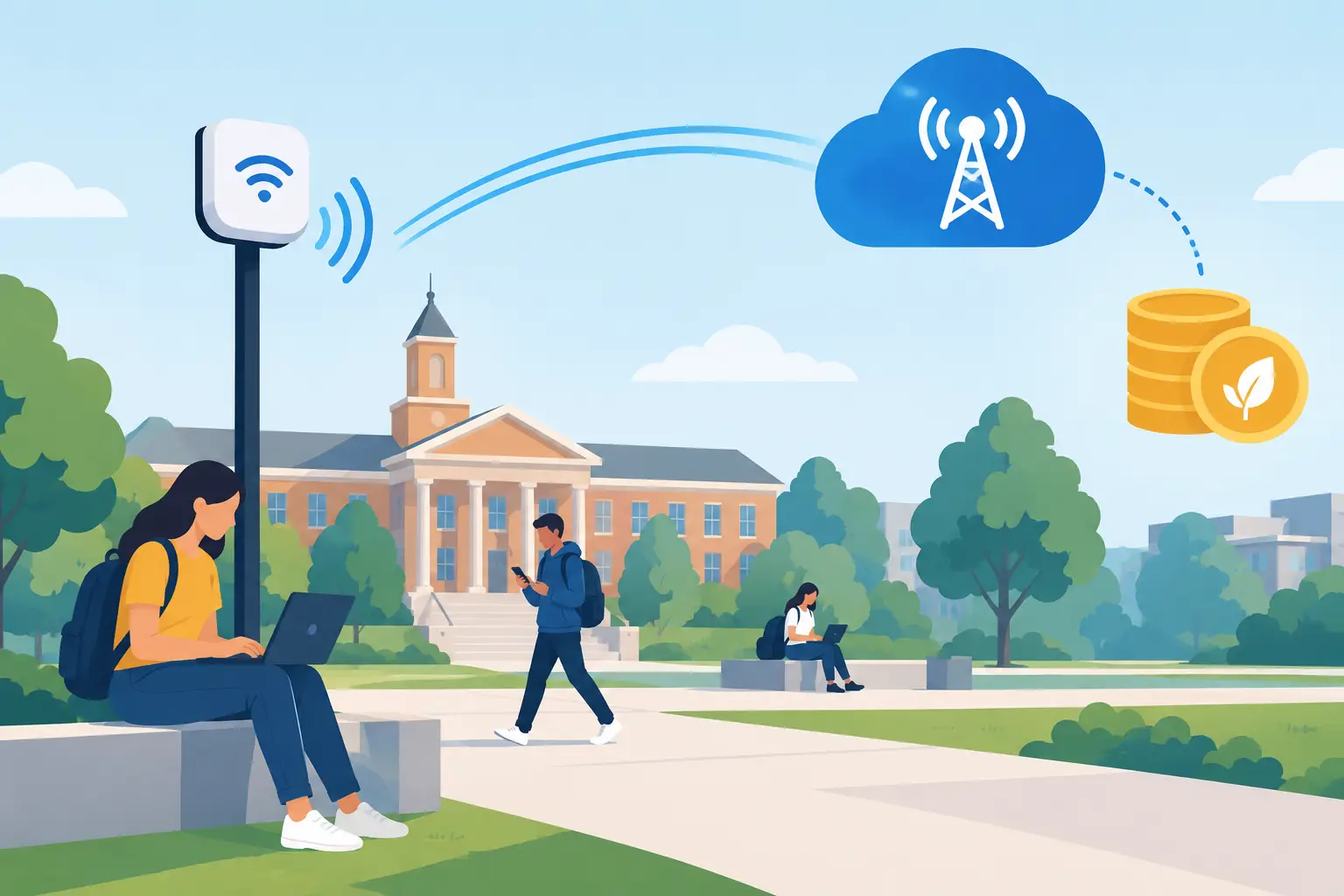
Wi-Fi offload offers another path. Think of the cellular network as a highway. In busy campus zones, carrier traffic can be directed onto a trusted Wi-Fi network, reducing pressure on the cellular highway without disrupting the user experience. The carrier gains capacity where it needs it. The university can gain a new financial use for infrastructure it already operates.
This is not the same as asking students to manually join a public guest network. Carrier-grade offload is designed to authenticate eligible users automatically and route their traffic through approved Wi-Fi infrastructure. Technologies such as WiFi Passpoint can make the connection feel familiar: the device recognizes a trusted network and connects securely without repeated sign-ins or captive portal friction.
For campus leadership, the opportunity is bigger than better Wi-Fi. It is about recognizing that a well-managed network, in the right location, may have commercial value beyond internal connectivity.
How University WiFi Carrier Offload Works
Carrier offload partnerships generally combine three elements: a qualifying location, carrier-grade network capability, and a commercial arrangement with a mobile carrier or its approved partners.
First, the campus must have meaningful demand. Enrollment alone does not determine value. A smaller urban university with a packed student center, heavy commuter traffic, nearby transit, and crowded event programming may be more strategically attractive than a larger campus with dispersed buildings and low-density usage.
Second, the Wi-Fi environment must support the expected experience. Carriers need confidence that users can connect reliably, move through key areas without excessive disruption, and receive adequate performance. Existing access points, backhaul capacity, coverage design, authentication methods, network segmentation, and operational oversight all matter.
Third, the institution must control, or have a workable path to control, the network environment. If a third-party provider owns the Wi-Fi hardware or manages the internet service contract, that does not automatically disqualify the campus. It does mean the commercial and technical relationships need to be reviewed early.
Once a location is validated, carrier traffic can be directed to the campus Wi-Fi under agreed conditions. The exact payment structure varies by partnership, network demand, geography, traffic value, and technical scope. This is not a generic advertising program or a promise that every access point produces income. It is a location-specific infrastructure opportunity.
The Campus Areas With the Strongest Potential
Universities often have more qualifying potential than they realize because value can be concentrated in particular zones rather than spread evenly across an entire campus. High-dwell-time environments are especially relevant. Students may spend hours in a library, residence hall, recreation center, study lounge, or student union while using multiple connected devices.
Event-driven locations can also be compelling. Stadiums, arenas, performing arts venues, conference centers, and graduation spaces experience sharp, predictable surges in wireless demand. A carrier may place significant value on added capacity during a game, concert, orientation, or major campus event.
Other strong candidates include dense academic buildings, dining commons, health clinics, parking and transit hubs, and outdoor quads where students gather between classes. A university does not need every corner of campus to be equally valuable. The most relevant question is whether specific areas combine strong foot traffic, long dwell time, dependable coverage, and strategic carrier demand.
What Universities Gain Beyond Potential Revenue
The most visible benefit is the possibility of recurring revenue from an asset the institution already funds. Universities continually invest in internet connectivity, access points, network security, support staff, and upgrades. Carrier offload can create a path for that infrastructure to contribute directly to the financial model rather than remaining solely a service expense.
There are operational benefits as well. A carrier-grade assessment can reveal coverage gaps, capacity constraints, and management issues that affect students, faculty, visitors, and campus operations. Even when a university pursues offload primarily for revenue, the process can support a more deliberate network modernization plan.
Better wireless capacity also supports the campus experience. Students expect dependable connectivity in residence halls, lecture spaces, and common areas. Visitors expect it during athletic events and admissions tours. Faculty rely on it for teaching tools, communications, and research workflows. Offload is not a substitute for serving those users well. It works best when it complements an already thoughtful connectivity strategy.
For multi-campus systems, the opportunity can be even more meaningful. A portfolio of locations creates more data points for evaluating carrier interest. One campus may be attractive because of stadium traffic, another because of urban density, and another because it sits near a congested mobility corridor. Portfolio review can identify where investment and commercial attention should be prioritized.
The Technical and Governance Questions to Address
A university should approach carrier offload with the same discipline it applies to any network, privacy, or vendor decision. The first question is whether carrier traffic can be separated from institutional traffic. Proper network design should protect academic, administrative, research, and operational systems through segmentation and clear policy controls.
Security and privacy are equally central. Student and institutional data should not be exposed through a carrier offload arrangement. Authentication, encryption, traffic handling, logging practices, and responsibility boundaries should be understood before deployment. The goal is to add a managed revenue layer without compromising the university's obligations.
Capacity is another real trade-off. A campus network that is already strained should not accept additional demand without upgrades, engineering, or clear service thresholds. Carrier participation must be designed around available capacity and quality standards, not treated as free money. In some cases, the commercial opportunity can help justify improvements that the university already needs.
Governance can be more complicated than technology. Procurement rules, board oversight, existing managed-service agreements, state requirements, research policies, and student privacy standards may shape what is possible. That does not eliminate the opportunity. It simply means a qualification process should involve IT, facilities, finance, legal, and procurement stakeholders early.
How to Evaluate a University Location
A credible evaluation starts with real operating facts, not broad assumptions about enrollment. Decision-makers should examine campus foot traffic patterns, dwell time, building density, event schedules, Wi-Fi coverage, internet capacity, and who controls the underlying network.
It also helps to understand the surrounding wireless environment. Is the campus located in a dense city center, near transit, beside a stadium district, or in an area where mobile demand rises at predictable times? Carriers value location-specific capacity, so surrounding conditions can matter as much as what happens inside a building.
The strongest next step is a location qualification review that tests commercial potential alongside technical readiness. WiFiRevenueCheck evaluates the practical factors that determine whether a venue can participate: traffic, dwell time, network control, coverage, and strategic relevance to carrier demand. That approach prevents universities from spending months evaluating an idea that may not fit their site, while giving qualified campuses a clearer route toward partnership.
A Different Way to Think About Campus Connectivity
Campus Wi-Fi has long been treated as an expected utility, much like lighting or heating. Students notice it when it fails, but few institutions view it as an asset capable of producing financial value. Carrier offload changes that conversation.
Not every university will qualify, and not every building needs to participate. The campuses most likely to benefit are those that combine dense real-world usage with a network they can manage confidently. For those institutions, the infrastructure is already in place. The opportunity is to assess whether it can do more than keep people connected - whether it can help fund the connected campus of the future.
Comments