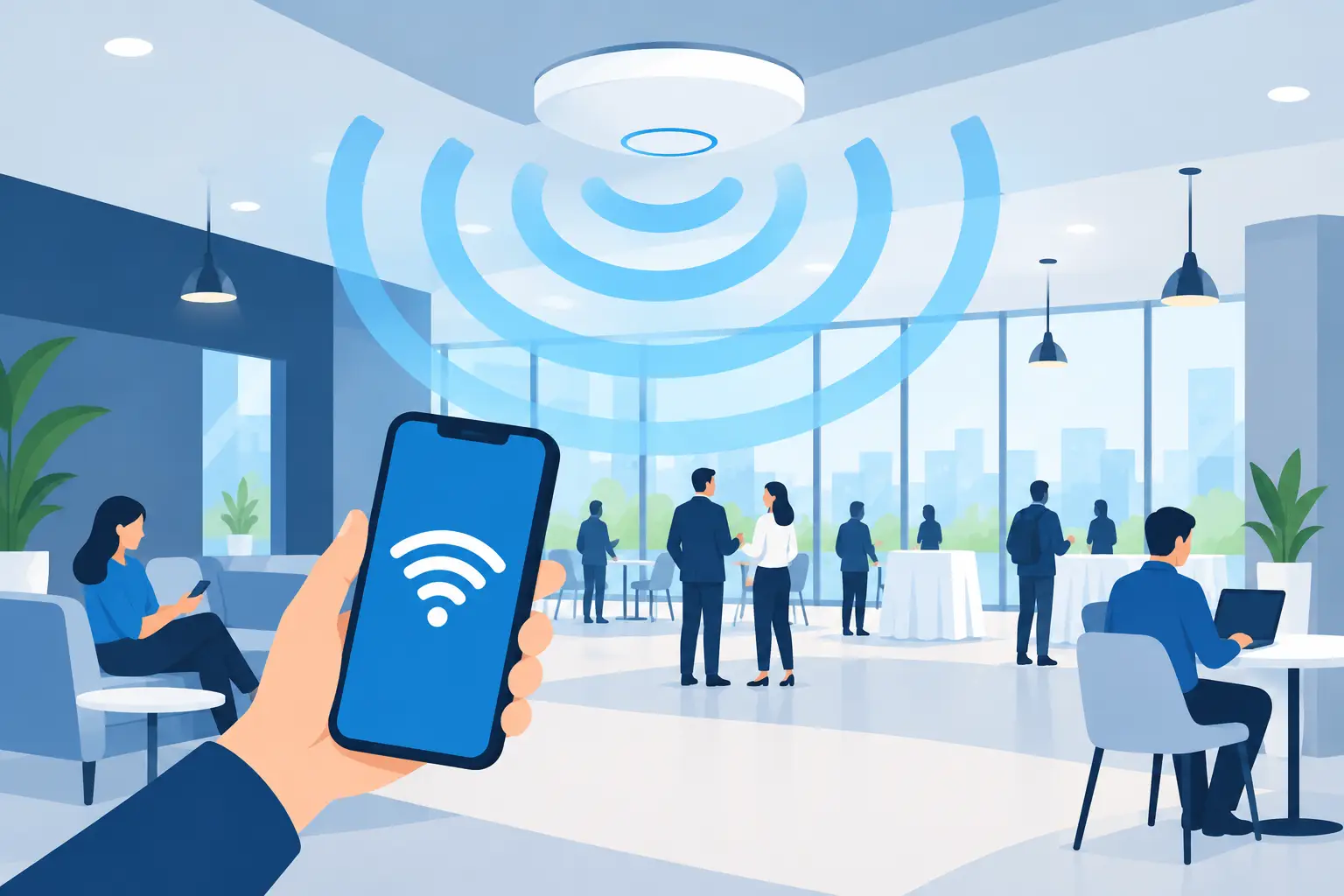
Improve Cellular Coverage With WiFi at Your Venue

Find out whether your location qualifies for carrier offload. If guests regularly reach for their phones in crowded rooms, struggle with indoor signal, or leave your Wi-Fi network as soon as cellular service returns, your existing network may be solving a bigger problem than guest internet access. It may be able to improve cellular coverage with WiFi while creating a new revenue opportunity for the property.
For businesses and venue operators, weak cellular service is not always a carrier problem that must be tolerated. In the right location, Wi-Fi can carry eligible mobile traffic when nearby cellular networks are congested or difficult to reach indoors. This model is called carrier Wi-Fi offload, and it turns a familiar operating expense into infrastructure with commercial value.
Why Cellular Coverage Breaks Down Indoors
A phone can show strong service outside and become unreliable the moment a guest walks through the door. Concrete, steel, low-emissivity glass, underground construction, dense shelving, and building layout can all interfere with cellular signal. Large crowds add another issue: too many devices competing for limited capacity on the same nearby cell sites.
Think of the cellular network as a highway. During normal traffic, vehicles move freely. At a concert, hospital shift change, conference, airport rush, or busy lunch period, too many vehicles try to use the same lanes. Calls may degrade, messages can lag, and data speeds fall precisely when people need them most.
Adding cellular towers or indoor distributed antenna systems can help, but those projects are not always fast, inexpensive, or practical for every property. Many locations already have a different path in place: managed Wi-Fi coverage, broadband backhaul, and people who spend enough time onsite to benefit from it.
How Wi-Fi Can Improve Cellular Coverage
Wi-Fi does not magically amplify a weak cellular signal. Instead, it can provide an alternate route for qualifying mobile traffic. When a participating carrier recognizes a compatible device on a trusted, carrier-enabled Wi-Fi network, traffic can move through Wi-Fi rather than competing for capacity on the cellular network.
The customer experience should feel automatic. With technologies such as WiFi Passpoint, eligible devices can identify and securely join an approved network without repeatedly searching for a network name, accepting splash pages, or typing passwords. Authentication happens in the background, and the phone uses the connection according to carrier policies and network conditions.
That distinction matters. Standard guest Wi-Fi is useful, but carrier offload requires more than a public network and a fast internet plan. The network must be engineered, controlled, and integrated to meet carrier-grade expectations for security, coverage, reliability, and traffic handling.
For the venue, the benefit is twofold. Guests can experience more dependable connectivity in a place where cellular service is strained, while the property may be compensated for carrying trusted carrier traffic. The infrastructure is already in place at many sites. The opportunity is to determine whether that infrastructure, location, and user behavior make the site commercially valuable.
Carrier Offload Is Not the Same as Free Guest Wi-Fi
Free Wi-Fi is generally a customer-service amenity. It helps people stay longer, work comfortably, browse products, stream content, or access digital services. Carrier offload can build on that foundation, but its purpose is different: it becomes part of decentralized wireless infrastructure.
A carrier may use qualified Wi-Fi locations to add capacity where demand is high, indoor coverage is difficult, or local cellular infrastructure is under pressure. The venue supplies a strategically placed layer of connectivity. In return, a qualifying operator can gain recurring revenue tied to the value of that network participation.
This is why location matters more than the size of the business alone. A small coffee shop beside a commuter hub may have more offload value than a larger building with little foot traffic. A medical campus may be compelling because visitors, patients, and staff remain onsite for long periods. A hotel may be attractive because guests use data heavily across predictable hours and indoor spaces.
What Makes a Location Valuable to Carriers?
The best candidates tend to combine consistent people traffic, meaningful dwell time, and Wi-Fi that reaches the places people actually use their phones. A carrier is not simply looking for any internet connection. It is evaluating whether a site can add useful capacity in a specific part of its network.
Four factors usually shape the opportunity:
Foot traffic: Regular device volume gives the network a reason to route traffic through the location.
Dwell time: A visitor who stays for 45 minutes, a workday, or several nights creates more value than someone passing through in two minutes.
Wi-Fi coverage and quality: Access points must provide dependable coverage, not just a strong signal near the front desk or register.
Network control: The operator needs the ability to support required upgrades, policies, and network management.
The surrounding area also matters. A venue near a stadium, university, hospital, convention center, transit corridor, dense retail district, or office cluster may sit in an area where added carrier capacity is particularly useful. The strongest opportunity often comes from the interaction between the building and the neighborhood around it.
Where Better Wi-Fi-Based Coverage Has the Most Impact
High-dwell-time venues are natural candidates because poor connectivity becomes noticeable when people cannot quickly leave the property. In hospitality, guests expect phones to work in rooms, meeting spaces, lobbies, and restaurants. In healthcare, reliable connectivity supports visitors and staff in buildings where construction can make radio signals difficult.
Retail centers and grocery stores benefit when shoppers use mobile apps, digital wallets, product research, and pickup notifications. Fitness centers, salons, restaurants, and coffee shops gain from keeping customers connected during repeat visits. Universities, offices, houses of worship, event spaces, and entertainment venues can have dense concentrations of devices that place real demand on nearby cellular capacity.
The business case varies by venue. A hotel may focus on the guest experience and recurring infrastructure revenue. A commercial property owner may see carrier offload as a way to increase the value of an amenity already included in operating costs. A multi-location operator may see an opportunity to standardize network improvements and identify which sites have the highest potential first.
What It Takes to Participate
A carrier-offload program is not a do-it-yourself toggle in a Wi-Fi controller. A location needs a qualification review and, when appropriate, a path to carrier-grade design, network optimization, and commercial partnerships.
First, evaluate the site honestly. Map the usable Wi-Fi footprint, not just the advertised coverage. Look at capacity during peak periods, broadband reliability, access point age, network segmentation, and who controls network decisions. A beautiful lobby with excellent service does not compensate for weak coverage in the guest rooms, treatment areas, sales floor, or event hall where people actually spend time.
Next, assess how people use the location. Foot traffic counters, occupancy patterns, visitor duration, event schedules, and repeat visits all help establish value. For a multi-site organization, compare locations rather than assuming every property should receive the same investment. The highest-traffic site is not automatically the best candidate if its visitors move quickly through the space or if the Wi-Fi network is outside the operator's control.
Finally, prepare for upgrades where needed. Older access points, undersized internet connections, incomplete coverage, or poorly separated guest and operational traffic can limit eligibility. Those improvements have costs, so the right decision depends on expected carrier interest, the condition of the current network, and the broader value of a stronger wireless experience.
The Trade-Offs Business Owners Should Understand
Carrier offload can create a new use for existing Wi-Fi, but it should not compromise the traffic that keeps the business running. Point-of-sale systems, security devices, staff tools, guest access, and operational applications need appropriate segmentation and performance protection. The network must be managed as business-critical infrastructure, not treated as an afterthought.
There is also no universal revenue figure or guarantee that every site will qualify. Carrier demand changes by market, surrounding coverage, device density, and strategic network needs. A property with excellent Wi-Fi may still be a poor fit if the local carrier network has plenty of capacity. Conversely, a venue in a constrained area may justify upgrades that would not make sense elsewhere.
That is why qualification should come before promises. A practical review connects the physical location, network condition, customer behavior, and local wireless demand to a real commercial opportunity.
Turn an Existing Expense Into a Network Asset
Your business Wi-Fi is not just providing internet anymore. At the right location, it can help carriers manage demand, give customers a better connection indoors, and create a recurring-income path from infrastructure you already operate.
WiFiRevenueCheck helps operators evaluate that opportunity based on the factors that matter: foot traffic, dwell time, Wi-Fi coverage, network control, and the strategic value of the surrounding area. The next useful move is not guessing whether your venue is too small or too ordinary. It is measuring whether the network beneath your roof has a bigger job to do.
Comments