How to Assess Venue WiFi Value for Carrier Revenue

Before you budget for another network upgrade, assess venue WiFi value through a different lens: could the network you already operate carry trusted cellular traffic and produce recurring revenue? For many businesses, the answer depends less on the square footage of the building than on what happens inside it - who visits, how long they stay, where coverage reaches, and whether the operator controls the network.
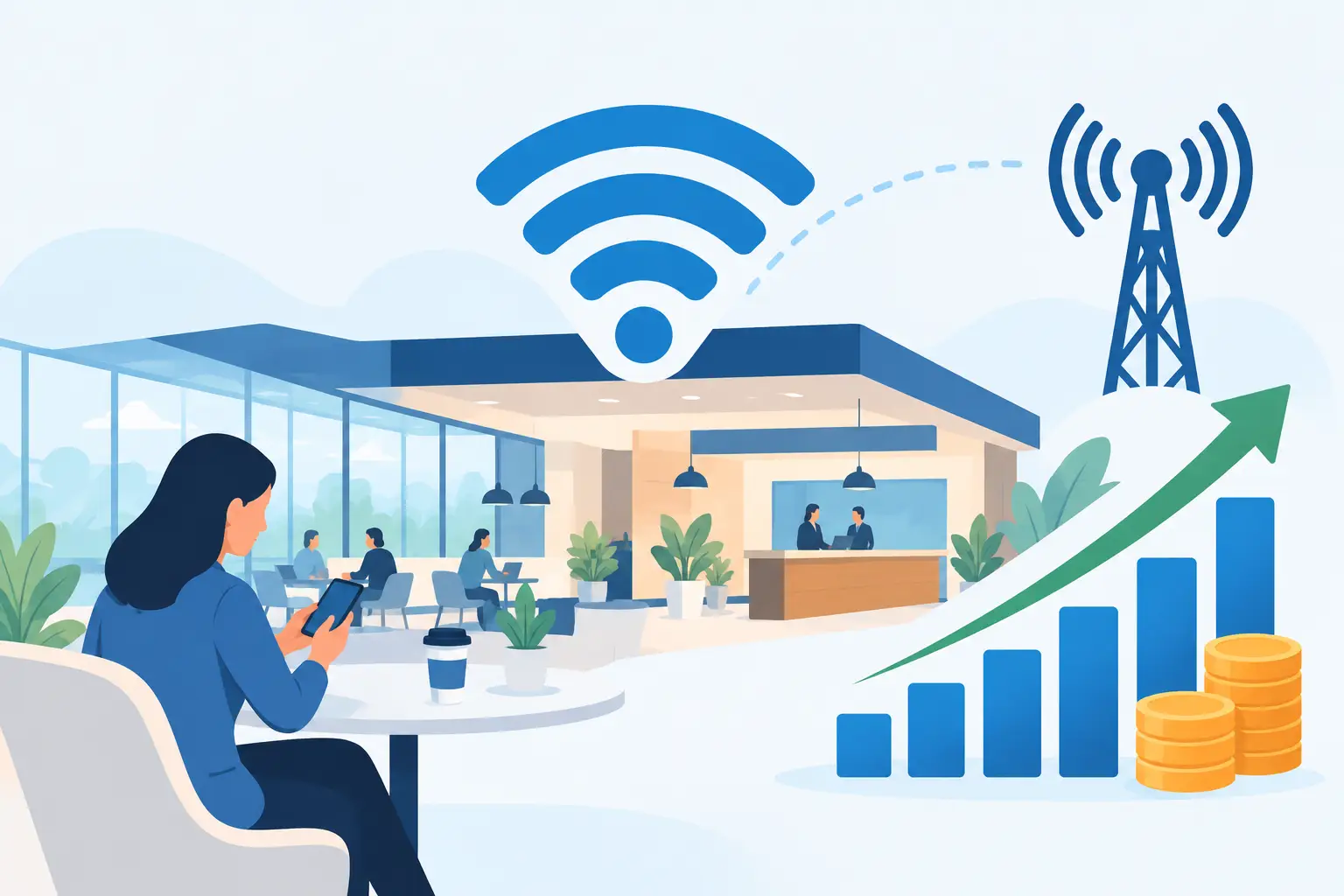
Carrier offload gives venue owners a way to turn WiFi from a customer-service cost into a telecommunications asset. When a mobile carrier can safely route eligible subscriber traffic through carrier-grade venue WiFi, it reduces pressure on nearby cellular capacity while customers get stronger connectivity where they spend time. The opportunity is real, but not every location has equal value.
Start With the Activity Inside Your Venue
A carrier does not evaluate WiFi monetization potential the way a guest evaluates free internet. A guest may only care that a page loads. Carriers care about whether a location can reliably absorb meaningful mobile traffic at the moments and places their networks need help.
That makes foot traffic and dwell time central to venue value. A busy coffee shop where customers spend 45 minutes working has a different profile than a convenience store with constant visits lasting three minutes. Both may have plenty of people, but the coffee shop creates more sustained opportunities for devices to connect, authenticate, and move data over WiFi.
High-value activity often appears in places where people wait, work, shop, gather, or consume content. Hotels, fitness centers, outpatient clinics, universities, office campuses, event venues, restaurants, and retail centers are strong candidates because people carry multiple connected devices and remain on-site long enough to use them.
Traffic volume alone is not the whole story. A smaller medical facility may be commercially attractive if patients, visitors, and staff spend long periods in a coverage-constrained area. Likewise, a large warehouse may have substantial staff presence but limited value if devices are restricted, WiFi is confined to offices, or cellular demand is already well served outside the building.
How to Assess Venue WiFi Value Beyond Speed Tests
A speed test is useful, but it does not tell the commercial story. To assess venue WiFi value for carrier offload, look at the network, the people using the space, and the location's strategic relevance together.
Measure repeatable foot traffic and dwell time
Start with what you already know from point-of-sale data, visitor analytics, occupancy reports, booking systems, or access control records. Estimate typical daily visitors, peak periods, operating hours, and average length of stay. Repeat traffic matters because carriers value predictable demand, not only occasional spikes.
A stadium may have enormous traffic but only on game days. That can still be valuable, particularly in a cellular-congested market, but its economics differ from a hotel with steady, around-the-clock occupancy. The right question is not simply, “How many people come here?” It is, “When are they here, how long do they stay, and how concentrated is their mobile demand?”
Confirm where your WiFi actually reaches
Coverage must extend to the places where guests, tenants, employees, or visitors spend time. A high-capacity connection at the service counter does little for carrier offload if meeting rooms, treatment areas, guest rooms, seating zones, or common corridors have weak signal.
Coverage quality also needs to be consistent. Thick concrete, metal shelving, elevator banks, outdoor seating, older access points, and poorly planned network layouts can create dead zones that lower the value of an otherwise busy venue. This does not automatically disqualify a location. It may identify a practical optimization opportunity before participation can begin.
Establish who controls the network
Network control is one of the most overlooked qualification factors. The owner or operator needs the ability to authorize network changes, support carrier-grade management, and participate in the commercial arrangement.
A tenant with its own WiFi inside a mall may have an attractive customer base but lack authority over building-wide infrastructure. Conversely, a property owner may control the network but not have visibility into tenant traffic patterns. Multi-location organizations should identify whether network decisions are made locally, regionally, or through a managed service provider. Clear control shortens the path from evaluation to deployment.
Look at capacity, reliability, and backhaul
Carrier traffic cannot be treated as an afterthought. Existing guest WiFi must still serve the people who depend on it, so the network needs enough capacity and a reliable internet connection to accommodate additional demand under defined operating standards.
This is where the highway comparison helps. Cellular networks are highways, and busy venues can create bottlenecks when many phones attempt to use the same nearby cell sites. Carrier offload opens a managed alternate route through your WiFi. If that route is narrow, unreliable, or poorly maintained, it cannot relieve congestion effectively. If it is well designed, it becomes useful infrastructure for both the carrier and the venue.
Consider the surrounding cellular environment
Location context can raise or lower venue value. A venue near a dense urban corridor, transit hub, airport, hospital district, convention center, university, or entertainment zone may be more attractive because local cellular demand is consistently high. A rural property can still qualify, especially where coverage is limited or a venue attracts a concentrated audience, but the commercial case may be different.
Carriers also value areas with changing demand. A downtown office tower may be quiet at night and crowded during business hours. A church may be active on weekends. A concert venue may generate sharp bursts of mobile usage. These patterns are not flaws. They are data points that help determine whether the venue supports a meaningful offload use case.
What a Valuable Venue Profile Looks Like
The strongest opportunities usually combine several factors rather than excelling in only one. A location is more compelling when it has:
Consistent visitor, guest, employee, student, patient, or attendee volume
Meaningful dwell time, especially during recurring peak periods
WiFi coverage across high-occupancy areas, not only back-office spaces
Operator control over the network and authority to approve changes
Reliable broadband capacity and a network that can be optimized for carrier-grade use
A setting where mobile demand is dense, variable, or likely to strain local cellular service
A venue does not need to check every box perfectly. A large retail center may have exceptional traffic but need coverage expansion. A boutique hotel may have excellent dwell time and network control but modest foot traffic. Qualification is about the complete picture and the improvements that are commercially reasonable.
Separate Guest WiFi From Carrier-Ready WiFi
Many operators hear “carrier offload” and assume they must build an entirely new network. In some cases, upgrades are necessary. In others, the core infrastructure is already in place and needs the right technical layer, network optimization, and commercial partnership.
Carrier-ready WiFi is designed to authenticate eligible devices securely and direct traffic according to agreed policies. Technologies such as WiFi Passpoint can allow compatible mobile devices to connect without asking users to hunt for a network name, enter a password, or repeatedly accept a splash page. For a visitor, the experience can feel automatic. For the venue, it is controlled, managed connectivity that supports a defined business purpose.
That distinction matters. A guest network built years ago for light browsing may not yet be ready for offload, but it still has value. The evaluation process identifies whether the gap is minor configuration work, added access points, improved backhaul, or a more substantial refresh. It also identifies locations where the economics do not justify changes. That clarity is better than spending money on a generic upgrade with no revenue plan behind it.
Build a Practical Location Assessment
The most useful assessment starts with a factual profile, not technical jargon. Gather the venue address, type of business, operating schedule, approximate daily traffic, typical dwell time, current WiFi provider, coverage areas, internet service details, and the person or team that controls network decisions.
Then add operational context. Are customers reporting weak cellular service? Do guests stream content, use apps, join video calls, or connect multiple devices? Are there predictable rushes after events, during shifts, or at check-in? Does the property include outdoor areas, parking zones, lobbies, waiting rooms, or common spaces that create demand beyond the obvious main floor?
For multi-site owners, avoid averaging every location into one number. A chain may have 40 sites, but only 12 may sit in high-demand areas with strong dwell time and full network control. Those 12 can be the best starting point. A focused rollout often produces more useful commercial and operational insight than trying to treat every property as identical.
Treat WiFi Like the Asset It Has Become
For years, venues paid for WiFi because guests expected it. That expectation remains, but the economics are changing. The same access points, broadband connections, and coverage plans can support an additional role in decentralized wireless infrastructure when a location meets the right conditions.
The opportunity is not a promise that every router produces passive income. It is a disciplined way to identify where existing infrastructure has underused commercial value and where targeted improvement can make a venue more useful to carriers and customers alike.
If your location has people, dwell time, usable coverage, and control of the network, it is worth submitting the facts for qualification through WiFiRevenueCheck. Your WiFi may already be doing more than providing internet. The next step is finding out whether it can become a revenue-producing part of the wireless network around you.
Comments